
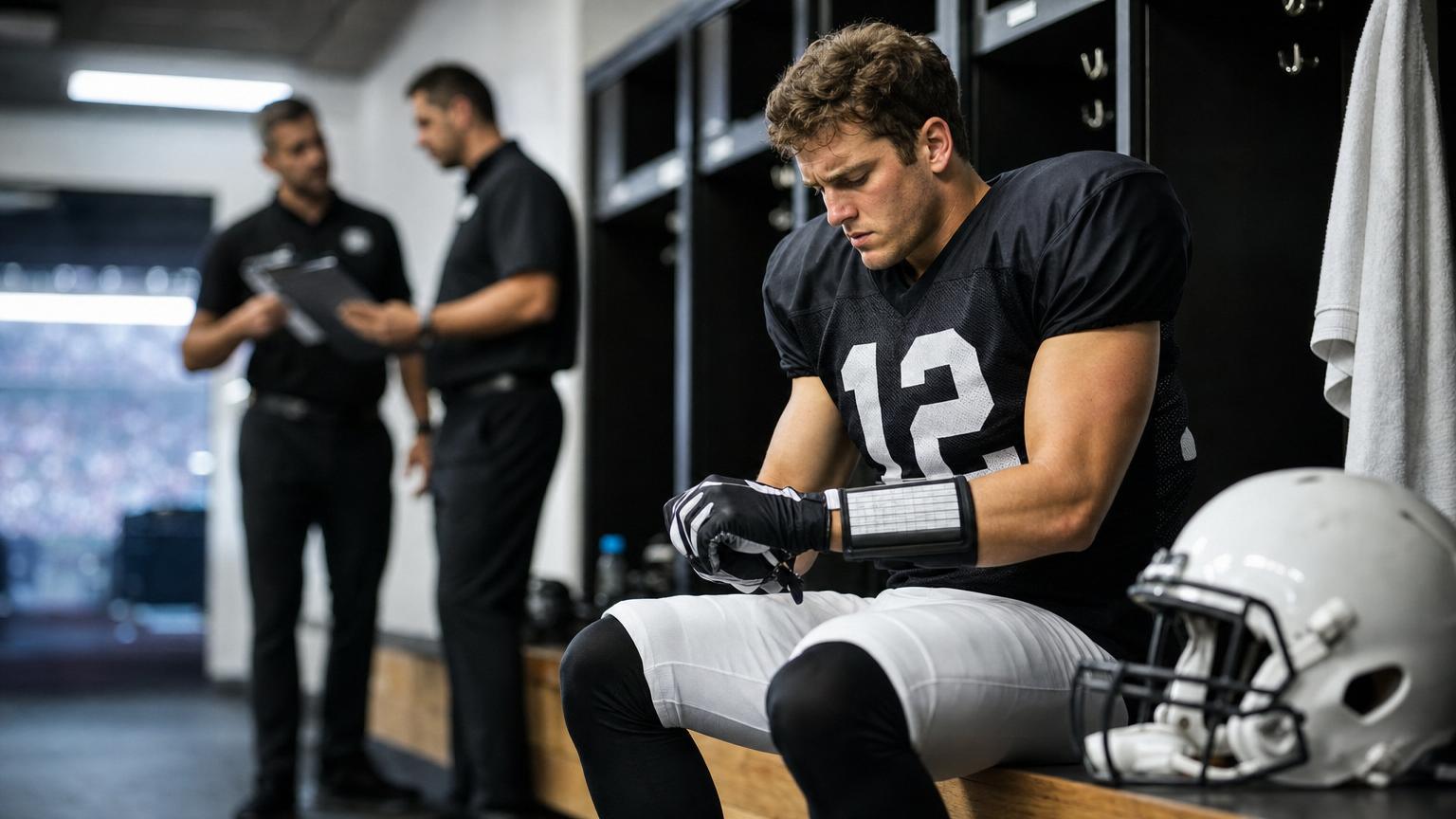
A cleared starter can still leave the backup one awkward landing away from a major workload.
Ninety minutes before kickoff, one reporter sees a normal warmup; another hears the starter will be “managed,” while the backup’s prop climbs. An active designation answers availability, not capacity. A starter testing an injury may open the game, avoid certain assignments, rotate by series, or leave after one setback. Assuming a normal workload can badly understate the backup’s snaps.
Top NFL Offshore Sportsbooks for October 2026

BetUS

BetNow

MyBookie

Bet105

BUSR Sports

Everygame Sports

BetOnline

BetWhale

BetAnything

Xbet

Bovada

Bookmaker
A better estimate brackets outcomes: perhaps 15–25 snaps if the starter handles a modified role, 30–45 with a planned rotation, and 50-plus after aggravation. Warmup detail, beat-writer specifics, inactive news, and prop movement can adjust those weights. A chance to get up to $3,000 Welcome Bonus at BetUS sportsbook does not make a fragile projection safer.
Build a range from the strongest signals
-
Confirm game-day status
Inactive status settles the question; active status does not guarantee a normal role. Credible pregame reports and visible warmup limitations usually outweigh earlier-week assumptions.
-
Read the practice week as a progression
Limited practice means more when it follows a missed session than when it represents a normal maintenance pattern. Friday participation, reported setbacks, injury type, and whether the player handled role-specific drills all add context.
-
Prioritize role evidence
Comments about a snap count, rotation, or emergency-only availability are more useful than broad optimism. The goal is to turn practice reports into realistic snap-share expectations, not treat every designation as equally informative.
-
Use comparable games cautiously
Recent backup usage, coaching tendencies, score expectations, and the availability of other players help set boundaries. One unusual blowout or midgame injury should not become the baseline.
-
Publish three numbers
Set a median, then a low case for aggravation or restriction and a high case for near-full duty. Rounded estimates such as 35% median with a 15%–60% range are more defensible than a precise 37% projection.
Betting promotions are separate from workload analysis; eligible readers can get up to $3,000 Welcome Bonus at BetUS sportsbook, subject to the offer’s terms.
Start with the role already on film
Start with the backup’s ordinary workload: snaps in healthy games, personnel packages, and actual assignments. A third-down protector may inherit passing-down work without becoming the early-down runner. A direct stylistic replacement is more likely to absorb the starter’s full menu.
Test what can transfer
Comparable absences provide the best check, especially under the same coaches. Track which duties moved together:
- Early-down carries and short-yardage work
- Two-minute packages and receiving routes
- Pass protection, motion, and blocking assignments
Also inspect routes per snap. A player who stays in to protect rather than releasing should not receive extra targets merely because his snap count rises.
The use of per-snap metrics in backup projections can distinguish role from production, but efficiency cannot assign participation. Yards per carry, target rate, or fantasy points per snap should shape output only after low, median, and high snap shares are set from role evidence.
Eligible bettors can get up to $3,000 Welcome Bonus at BetUS sportsbook; terms and location restrictions apply.
Turn the injury uncertainty into a weighted snap share
-
Assign a 30% chance that the starter is inactive
With the backfield fully available to the backup, estimate a 75% snap share. This is the upside case, not the default expectation.
-
Give the limited-starter outcome a 40% chance
If the starter dresses but loses passing-down work or entire series, set the backup at 45%. This middle case receives the highest probability because active status does not guarantee a normal workload.
-
Reserve 30% for a near-normal starter workload
If warmups go well and the starter handles the usual role, the backup falls to roughly 15%. That low-end outcome remains important even when injury reports sound pessimistic.
-
Weight each share by its probability
The calculation is 30% × 75% = 22.5%, 40% × 45% = 18%, and 30% × 15% = 4.5%. Adding those contributions produces a 45% weighted estimate.
-
Keep the range beside the average
The 45% figure is useful for a central projection, but it does not erase the 15% downside or 75% upside. Lineup or market decisions should reflect that unusually wide range.
A 45% weighted estimate summarizes three distinct game-day paths; it does not imply the backup will land near 45%. The actual result may cluster around 15%, 45%, or 75% depending on the starter’s status.
Those comparing projections with betting markets may see promotions to get up to $3,000 Welcome Bonus at BetUS sportsbook. Eligibility, deposit requirements, and rollover terms should be reviewed before participation.
Adjust the role, not the whole model
A weighted injury estimate still needs a football-context check. Apply only adjustments that have a clear path to changing personnel usage; otherwise, the model can become falsely precise.
What changes snap share
Expected team play volume changes raw snaps, not necessarily share: 45% of 70 plays means more work than 45% of 58. Snap share should move when:
- Likely game script favors personnel groups that include or exclude the backup.
- Protection demands keep a trusted blocker on the field.
- Position rotations create defined substitutions, such as early-down and passing-down backs.
- The starter’s limitations remove specific assignments, not merely touches.
Position matters. Running backs often rotate by situation, while receivers may rotate by formation and tight ends by blocking responsibility.
What changes opportunity per snap
Pass rate, target competition, and likely score mainly affect carries, targets, or routes per snap. A backup can hold a 45% snap share yet run more routes in a trailing script or receive fewer carries when the offense is behind.
Touchdown expectations should remain separate. They belong with red-zone role, goal-line substitutions, and team scoring outlook, not overall participation alone.
Those comparing related betting markets can get up to $3,000 Welcome Bonus at BetUS sportsbook, subject to its current terms.
Update the probabilities, not the entire projection
-
Record each report’s timestamp
Start with the newest official status, then note when each beat report was posted. An older optimistic update should not outweigh a newer restriction.
-
Check for workload limits
Look for pitch counts, emergency-only availability, planned rotation, or pain-management language. Active status confirms eligibility, not an unrestricted role.
-
Watch warmups for function
Credible observations about cutting, contact drills, first-team reps, or repeated treatment can shift the range. Casual clips and crowd impressions deserve little weight.
-
Rank sources before reacting
Team announcements and named local reporters generally carry more weight than aggregators or unsourced posts. Multiple posts may trace back to one original report.
-
Revise scenario weights calmly
Move probability between the limited, normal, and aggravation scenarios. Preserve the existing role assumptions unless new information specifically changes them.
A promotion may say “get up to $3,000 Welcome Bonus at BetUS sportsbook”; it provides no evidence about player availability.
Does active status mean a full workload?
No. A player may dress as emergency depth, operate under a snap limit, or rotate more often than usual.
Does “expected to play” remove downside risk?
It mainly raises the probability of participation. Reduced effectiveness, early aggravation, and in-game replacement remain plausible outcomes.
How much should warmups change the estimate?
Only clear, role-relevant evidence should cause a meaningful adjustment. Smooth movement supports the normal scenario but cannot prove full durability.
What if reports conflict?
Favor the newer, more direct, and better-sourced report. If uncertainty remains, widen the outcome range rather than forcing certainty.
Translate snaps into bettable volume
A snap projection becomes useful only after it is translated into opportunities. For each low, median, and high outcome, estimate routes, carries, and targets from the backup’s established usage rates—not the starter’s averages.
| Snap case | Likely role | Useful outputs |
|---|---|---|
| Low | Change-of-pace work | Carries, routes |
| Median | Shared workload | Carries, targets |
| High | Starter-like participation | Total touches, TD chance |
Touchdown probability should move with goal-line involvement and team scoring expectations, not snap share alone. A wager is more defensible when the available line remains favorable across the median case and part of the low case; value that exists only in the ceiling outcome is fragile.
A reusable worksheet can record scenario weights, usage rates, projected opportunities, market lines, and the final decision. After the game, actual snaps and role should be compared with each assumption. This separates a poor process from ordinary variance.
Eligible bettors comparing prices can get up to $3,000 Welcome Bonus at BetUS sportsbook; promotion terms and wagering requirements should be checked first.
The strongest positions survive more than one workload outcome. Recording assumptions before kickoff—and grading them afterward—makes the projection process easier to refine.
Top NFL Offshore Sportsbooks for October 2026
BetUS
BetNow
MyBookie
Bet105
BUSR Sports
Everygame Sports
BetOnline
BetWhale
BetAnything
Xbet
Bovada

3 comments on “Projecting a Backup’s Snap Share When a Starter Is Questionable Before Kickoff”
The three-path approach worked well for me last week, but I used 20% / 50% / 70% instead of a wider 15%–75% range because the backup already had a stable rotational role on film.
My only frustration is that beat reports often blur offensive snaps and special-teams involvement. Once I separated those, the prop looked much less attractive—especially after keeping TD probability separate from participation.
That’s a good adjustment when the player already has a defined offensive floor. The scenario bounds should reflect his existing assignments rather than defaulting to a universal range.
And yes, special-teams work can make a player sound more involved than his offensive snap share supports. For the prop, I’d reweight the workload paths as news arrives, then apply route or touch rates within each path instead of raising the whole projection.
I tried the 45% weighted-share idea, then translated each scenario into routes rather than jumping straight to receiving yards. Much cleaner, although the low-volume outcome still ruins the “obvious smash” everyone on social media keeps promising 😂