
A familiar logo may catch the eye, but the minus sign determines what each win is worth.
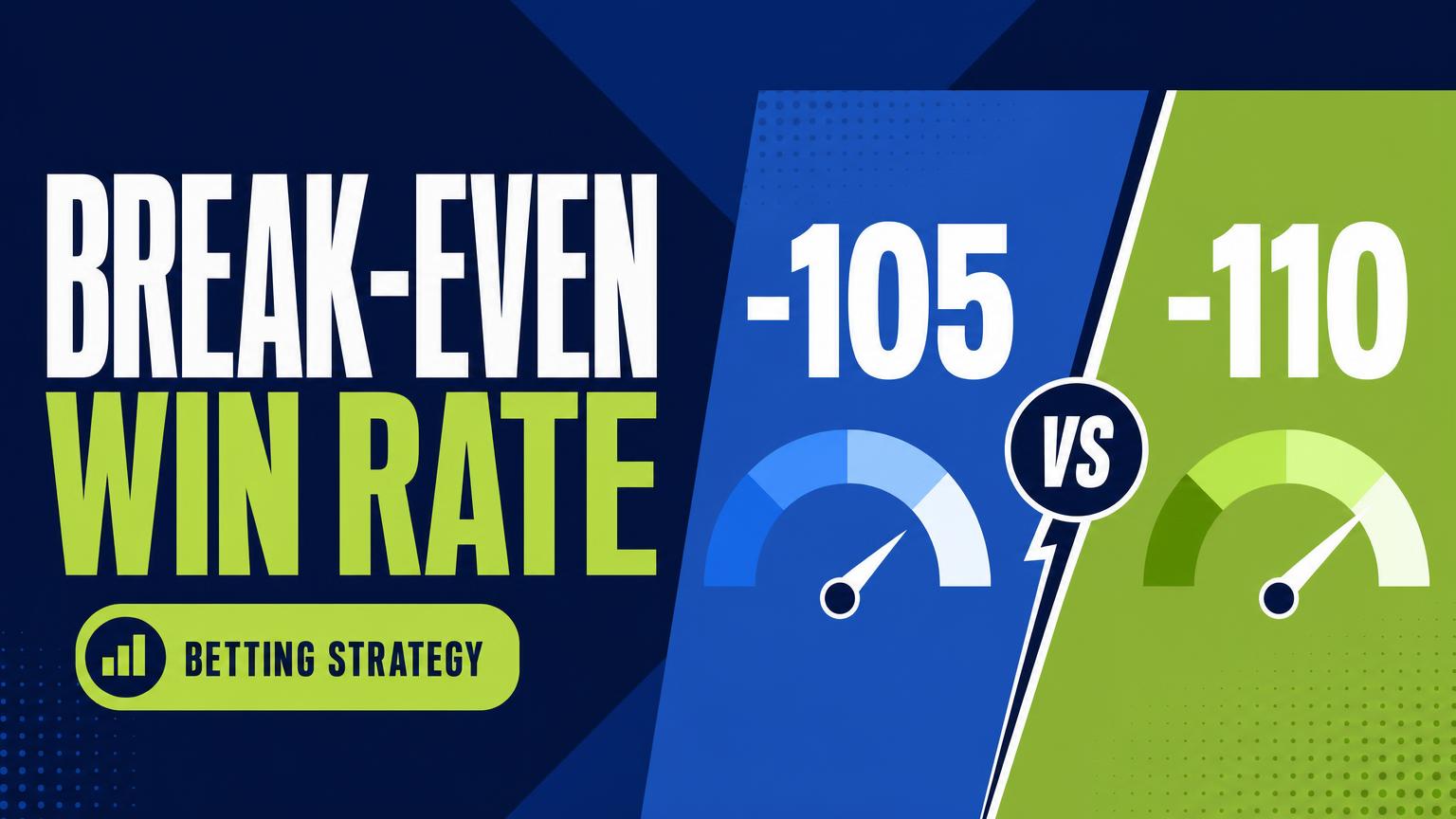
A bettor finds the same Super Bowl spread at two sportsbooks: -105 at one, -110 at the other. The teams and bet are identical, yet the cheaper price lowers the win rate needed to break even—from 52.38% at -110 to 51.22% at -105.
Top NFL Offshore Sportsbooks for September 2026


Across 100 bets, a 53–47 record produces $365 at -105 when risking $105 to win $100. At -110, that same record earns only $130—a $235 difference. Offers such as “get up to $3,000 Welcome Bonus at BetUS sportsbook” may be appealing, but eligibility, rollover rules, and long-term line prices all affect actual value. Branding cannot erase higher betting costs.
What -105 and -110 Actually Mean
-105
A $105 stake is required to make $100 in profit. Excluding pushes, the break-even win rate is 51.22%.
-110
A $110 stake is required to make $100 in profit. Excluding pushes, the break-even win rate rises to 52.38%.
Price, not prediction
Negative odds can price a spread or total; they do not identify the expected winner. This distinction is central to how Super Bowl lines work.
Like-for-like comparison
Compare prices only when the team or side, market, point value, and grading rules match. A half-point difference can matter more than a five-cent price difference.
Bonus terms
The offer to get up to $3,000 Welcome Bonus at BetUS sportsbook has separate eligibility and rollover terms; it does not make mismatched lines directly comparable.
The win rate each price demands
Break-even win rate is the percentage of settled bets that must win for profits and losses to offset, before taxes or other costs. Pushes are excluded because they return the stake.
For negative American odds, the formula is:
Break-even win rate = |odds| ÷ (|odds| + 100)
That produces two useful benchmarks:
- -105: 105 ÷ 205 = 51.22%
- -110: 110 ÷ 210 = 52.38%
The 1.16-percentage-point gap explains why a cheaper line matters across repeated, equal-sized wagers. The broader relationship between vig and break-even win rate shows how the sportsbook’s price raises the winning percentage required to avoid a loss.
This threshold is implied by the price; it does not forecast the game or claim that a bet will win that often. Estimating the actual win probability still requires handicapping. Promotions—such as the chance to get up to $3,000 Welcome Bonus at BetUS sportsbook—may affect account value, but bonus terms, rollover requirements, and eligibility do not change the line’s underlying break-even calculation.
The five-cent difference in win rate
For negative American odds, the break-even rate equals the amount risked divided by the total potential return.
| Line | Calculation | Break-even win rate |
|---|---|---|
| -105 | 105 ÷ 205 | 51.22% |
| -110 | 110 ÷ 210 | 52.38% |
The gap is 1.16 percentage points, not a 1.16% increase. Put simply, -105 permits a slightly lower long-run winning rate because less money is risked to win the same $100. Over 100 settled bets, that difference is conceptually equivalent to needing about 1.16 fewer wins, although real betting records use whole wins.
The advantage may look modest, but it compounds across repeated wagers. This comparison assumes identical bets, flat stakes, and no pushes or fees.
Promotions should be evaluated separately from line value. An offer to get up to $3,000 Welcome Bonus at BetUS sportsbook may carry deposit, eligibility, and wagering requirements; it does not change the underlying break-even percentage of -105 or -110 odds.
What five cents means in dollars
Using a fixed $100 risk makes the price difference easy to see. A winning wager at -105 returns about $95.24 in profit, while the same risk at -110 earns only $90.91.
| Price | Profit per win | Loss per defeat |
|---|---|---|
| -105 | $95.24 | $100 |
| -110 | $90.91 | $100 |
Now consider 100 settled wagers with a 52–48 record. At -105, the 52 wins generate roughly $4,952 in profit, while the 48 losses cost $4,800. The result is about +$152.
At -110, those wins produce approximately $4,727 against the same $4,800 in losses. That leaves the bettor around -$73, despite finishing four wins above .500. The lower price creates a swing of roughly $225 without changing a single pick.
That advantage is cumulative, not predictive. Getting -105 instead of -110 reduces the cost of repeated betting, but it cannot make one Super Bowl wager win; the selected side still has to cover.
Promotions can also affect overall value, although they should be assessed separately from the line itself. Eligible players can get up to $3,000 Welcome Bonus at BetUS sportsbook, subject to the offer’s eligibility, rollover, and withdrawal terms.
Check what the cheaper line gives up
-
Match the market first
Confirm that both offers cover the same team, spread, game period, and bet type. A full-game spread cannot be compared directly with a first-half line or an alternate spread.
What to checkIdentical markets with different pricesWhat can misleadTreating similar-looking wagers as equivalent -
Value the half-point
When choosing between -105 and -110, check whether the cheaper price moves the spread. For example, +3 at -110 may beat +2.5 at -105 because a three-point loss becomes a push instead of a loss.
What to checkMovement across key margins such as 3 or 7What can misleadSaving five cents while surrendering a valuable number -
Inspect settlement rules
Check whether overtime counts, how pushes are refunded, and when a postponed or shortened game is voided. Books can grade superficially identical bets differently when unusual circumstances arise.
What to checkClear overtime, push, postponement, and void termsWhat can misleadAssuming every sportsbook settles bets the same way -
Separate promotions from line value
An offer such as “get up to $3,000 Welcome Bonus at BetUS sportsbook” should be assessed through its eligibility, rollover, and withdrawal conditions. A bonus does not automatically compensate for an inferior spread.
What to checkTerms that fit the planned betting activityWhat can misleadLetting headline bonus size override price and points
A projection is not a result
The break-even rate comes directly from the odds, but true win probability is only an estimate. Suppose a bettor rates a Super Bowl selection at 52%. That opinion sits above -105’s 51.22% threshold, producing a theoretical return of about +1.52% per dollar risked.
At -110, the same 52% estimate falls below the 52.38% break-even point. The theoretical return becomes roughly -0.73% per dollar risked. A modest pricing difference therefore changes the wager from positive to negative expected value—if the 52% assessment is accurate.
That condition matters. A model, handicap, or market read can be wrong, and even a genuine edge may lose on one game or over a short run. Promotional value, such as the chance to get up to $3,000 Welcome Bonus at BetUS sportsbook, should also be evaluated separately from the underlying wager probability and applicable terms.
Consistently beating the market’s final price may indicate better estimates, as explained in the difference between break-even rate and closing line value. Still, closing line value is evidence of a sound process—not a promise of realized profit.
One game proves almost nothing
A single Super Bowl produces only a win, loss, or push—not enough evidence to separate sound forecasting from luck. Even a well-priced wager can lose, while a poor estimate can cash because of one turnover, penalty, or late score.
A stronger review compares a meaningful sample of historical lines and results, recording the offered price, closing line, projected probability, and outcome. Hundreds of comparable bets reveal calibration and profitability better than one headline game. Promotional value—such as “get up to $3,000 Welcome Bonus at BetUS sportsbook”—should be tracked separately and checked against its terms.
Special cases that change the calculation
Should pushes count in the settled win rate?
No. Use wins ÷ (wins + losses), excluding pushes from both sides of the fraction. Track pushes separately because a high push count can still reveal something about line selection.
Which price determines a parlay’s break-even rate?
Use the final combined price offered for the entire parlay, not an average of the individual legs. For decimal odds, the break-even probability is 1 ÷ decimal price; American odds should first be converted to implied probability.
Can a middle be treated like one ordinary bet?
Not cleanly. A middle has several paths: either side can win alone, both bets can win, and pushes may alter settlement. Sound middling and break-even calculations assign a probability and net payoff to each possible result.
Does a welcome bonus lower the posted break-even rate?
No. The break-even rate attached to -105 or -110 comes strictly from the posted odds. Any promotional value belongs in a separate calculation that reflects whether the bonus can actually be claimed and converted.
A message such as “get up to $3,000 Welcome Bonus at BetUS sportsbook” may affect overall account value, but it does not change the implied probability of a posted line.
The offer is subject to eligibility, location, wagering requirements, and full terms. Until those conditions are modeled, bonus value should not be added to the expected return of a -105 or -110 wager.
A practical pre-bet checklist
-
Verify the exact market
Confirm the same team, spread, game period, and settlement terms.
-
Record live prices
Note odds and timestamps before prices move; screenshots prevent memory errors.
-
Check break-even rates
-105 requires 51.22%; -110 requires 52.38%. Compare each with the estimated win probability.
-
Review rules and limits
Check push, overtime, void, and stake rules. Treat “get up to $3,000 Welcome Bonus at BetUS sportsbook” as conditional on eligibility, rollover, and withdrawal terms.
-
Choose overall value
Favor expected value after line quality, rules, and limits—not merely the lowest vig. Pass without a defensible edge.
-
Keep stakes modest
Use small, consistent stakes relative to the available bankroll.
Price matters only when the wager remains equally strong. If no defensible edge survives the checks, passing is the strongest decision.
With a modest bankroll, keep stakes small and fixed. Gambling should remain affordable entertainment; set limits and never risk money needed for bills.

1 comment on “Break-Even Win Rate: Choosing Between -105 and -110 Super Bowl Lines”
How would you handle a case where -105 is available at -2.5, but the -110 book has -2 with a push possible? The cheaper juice looks better on paper, but it seems like you’d need to assign a value to that half-point before comparing break-even rates.