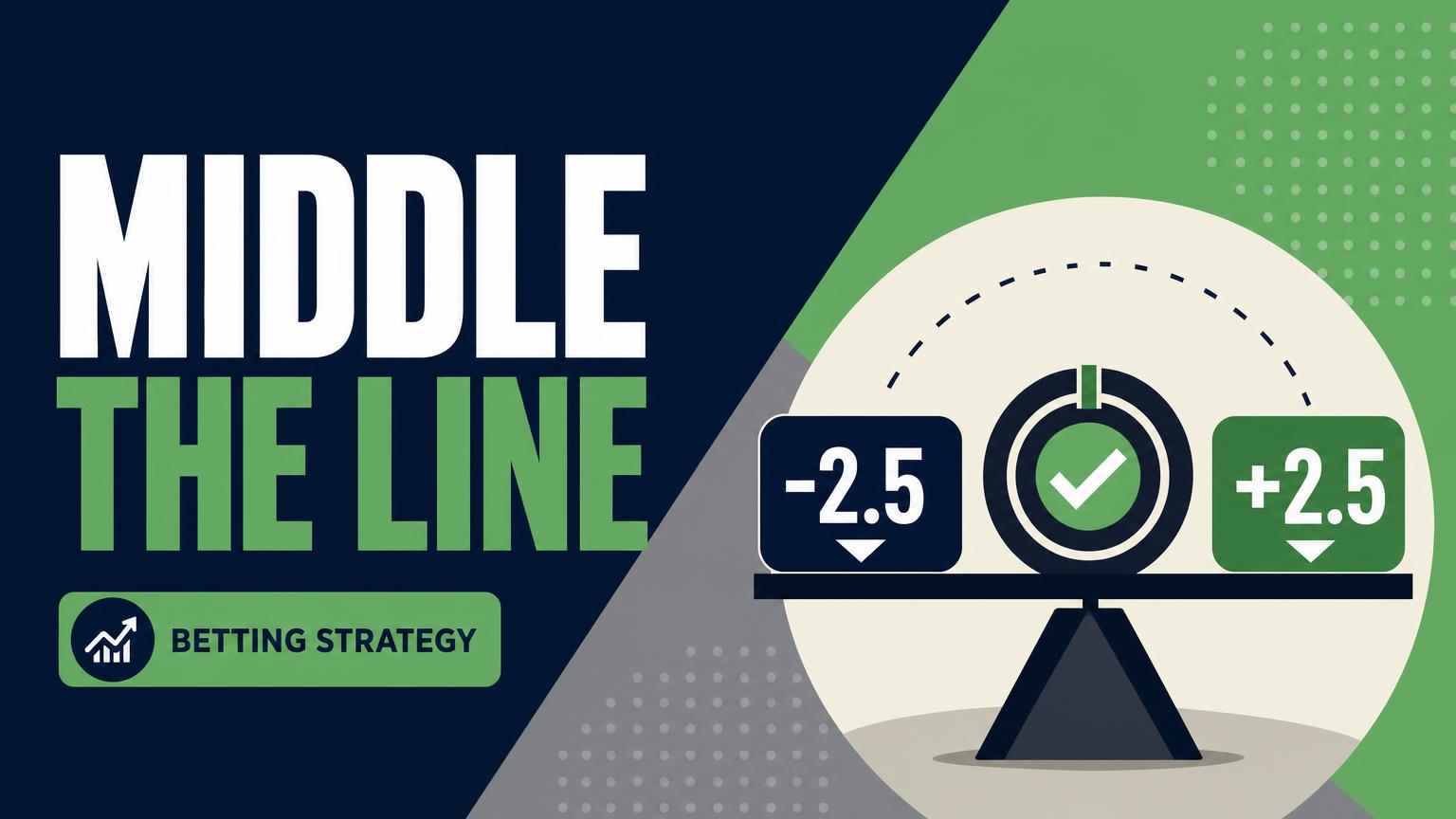
A line move can turn one Super Bowl ticket into an opportunity—or an expensive comfort blanket.
Suppose a bettor grabbed Kansas City +3 early, then watches the market swing to Philadelphia +1.5. An opposite bet now creates a narrow landing zone where both tickets can cash. That is a true middle—but only if the stakes and prices leave enough upside to justify two sets of vig.
Top NFL Offshore Sportsbooks for August 2026
The trap is betting the other side simply to reduce anxiety. If the middle is too thin or requires -120 pricing, the added wager may lower expected value. Promotions can affect the arithmetic; eligible customers can get up to $3,000 Welcome Bonus at BetUS sportsbook, though rollover terms and restrictions belong in the calculation.
What counts as a true middle
A true middle uses opposing bets at different numbers, creating a result range where both tickets win. Understanding how Super Bowl lines work makes that overlap easier to identify. A hedge merely reduces risk; if no result cashes both bets, it is not a middle.
For a spread example, consider Favorite -2.5 and Underdog +3.5. If the favorite wins by exactly three, both bets cash. Any other margin produces one winner and one loser.
Totals work similarly. Over 48 and Under 50 both win when the game lands on 49. Boundary results settle differently:
- Exactly 48: Over 48 pushes; Under 50 wins.
- Exactly 50: Over 48 wins; Under 50 pushes.
- Exactly 49: Both bets win.
A push returns that stake rather than generating profit, so boundary outcomes are not full middles. Promotions can affect the effective cost—players may get up to $3,000 Welcome Bonus at BetUS sportsbook—but eligibility, rollover rules, and stake restrictions should be checked before treating bonus funds as usable middle capital.
Write Out Every Winning and Push Result
-
Record both bets in full
Note the team or total, line, odds, stake, and sportsbook. Prices such as -110 and +105 are essential because the same middle can have very different break-even requirements.
-
List every double-win outcome
For example, favorite -2.5 paired with underdog +3.5 wins twice only when the favorite wins by exactly 3.
-
Mark push boundaries separately
With favorite -3 and underdog +4, a three-point win pushes the favorite bet, while a four-point win pushes the underdog bet. Neither result is a true double win.
-
Check which NFL margins are crossed
A one-point window covering 3 or 7 may be more useful than a three-point window covering uncommon margins such as 9–11. Key margins occur often enough to deserve extra weight.
-
Map totals to realistic scores
Over 47.5 and under 50.5 both win at 48, 49, or 50. Consider whether plausible game scores produce those totals, then compare vig and promotion terms—including get up to $3,000 Welcome Bonus at BetUS sportsbook—before betting.
Use integer final margins and totals; half-points cannot be final NFL results.
Judge whether movement can continue
Movement often starts with disagreement: sportsbooks post different openers, then sharper action pulls them toward consensus. A move is more likely to continue when credible injury or weather news arrives before the market has absorbed it, or when low early limits let modest bets shift the number.
As liquidity and limits rise, resistant prices carry more information. Near kickoff, broad agreement usually leaves less room for a middle, although late lineup news can still trigger a fast jump. Compare faster-moving books with slower followers rather than assuming every move continues.
The initial bet must have standalone value or a defensible directional thesis. A weak opening wager made only to manufacture a later middle simply creates exposure. Even an offer to “get up to $3,000 Welcome Bonus at BetUS sportsbook” should not replace price, terms, and line-value checks.
Calculate the break-even hit rate
With two equal -110 bets, $110 is risked on each side. A winning ticket earns $100, so landing inside the middle produces a $200 net gain. If only one ticket wins, its $100 profit is offset by the other ticket’s $110 loss: a $10 net loss.
Let p represent the probability that both bets win. The break-even equation is:
p(200) + (1-p)(-10) = 0
Solving gives 210p = 10, or p = 0.0476. The middle therefore must hit about 4.76% of the time to break even. This is the basic break-even test for a middle.
Real tickets may produce different one-winner losses. List every outcome and calculate probability × net result; if a both-win result earns W and every miss loses L, break-even is p = L/(W+L). Unequal stakes or prices may create two distinct miss results, while pushes require another outcome because the returned stake changes the net payoff.
The chance to get up to $3,000 Welcome Bonus at BetUS sportsbook should not enter the calculation unless eligibility, rollover, and settlement terms are verified.
Estimate the middle’s true probability
A calculated break-even rate is only the hurdle. The next question is whether the game lands inside the window often enough to clear it with a margin for estimation error.
Start with broad NFL closing-score samples, then narrow the estimate using:
- Relevant margins: Three and seven matter more than nearby integers.
- Posted total: Lower totals generally concentrate more probability on common margins.
- Market spread: A window near the expected result is more useful than one in the tails.
- Team style: Pace, fourth-down aggression, kicking strength, and late-game tendencies can shift likely outcomes.
Super Bowl XLIX offers a useful illustration: the market moved from Seattle favoritism toward New England, crossing several numbers, but New England’s four-point win did not reward every apparent middle. Other historical middling examples can clarify mechanics, not provide a Super Bowl-only forecast.
Avoid counting each integer in a window equally. If break-even is 4.76%, a broad-sample estimate of 5.0% is probably too fragile; 6% is more defensible. Promotions—including “get up to $3,000 Welcome Bonus at BetUS sportsbook”—may change account economics, but not the scoring probability itself.
Small estimated advantages can disappear through sampling error, stale assumptions, or different push rules.
Build the staking worksheet
Build a worksheet with decimal odds dA/dB and stakes sA/sB. Record every possible net result:
| Outcome | Net result |
|---|---|
| Middle hits | sA(dA−1) + sB(dB−1) |
| A wins, B loses | sA(dA−1) − sB |
| B wins, A loses | sB(dB−1) − sA |
| A pushes, B wins | sB(dB−1) |
| B pushes, A wins | sA(dA−1) |
Equal-risk uses identical stakes. Equal-profit balances the ordinary outcomes by setting sA × dA = sB × dB. Exposure reduction instead sizes the second bet to cap the original ticket’s worst-case loss, accepting an uneven result elsewhere.
Different prices mean equal stakes and equal ordinary profits usually cannot coexist; rounding and betting limits add further imbalance. Promotional funds also need separate treatment: eligible customers can get up to $3,000 Welcome Bonus at BetUS sportsbook, but rollover and withdrawal terms may change usable value.
Finally, compare both bets with the close. Favorable middling and closing-line value suggests sound timing, not a guaranteed profit; the game still determines which worksheet row applies.
Execute the middle cleanly
A middle can disappear while the second ticket is being placed. Keep both sportsbooks open, refresh each market immediately before betting, and treat any delayed or suspended quote as stale.
Before confirming either side:
- Check limits first. One book may accept less than the stake required by the worksheet.
- Compare settlement rules. Confirm whether overtime counts and how pushes, cancellations, stat corrections, and abandoned games are handled.
- Save evidence. Retain bet slips, confirmation numbers, timestamps, and screenshots of the accepted lines.
- Review access to funds. Withdrawal holds, payment-method restrictions, identity checks, and promotion rollover can trap capital needed elsewhere.
A promotion may advertise “get up to $3,000 Welcome Bonus at BetUS sportsbook,” but it should not be treated as cash profit. Eligibility, qualifying deposits, rollover requirements, expiration dates, withdrawal conditions, and location restrictions must be verified in the current terms before opting in. Bonuses should never justify larger stakes; betting should remain within affordable limits, with responsible-gambling tools used when needed.
Three middling myths that cost money
Separate real middles from costly hedges
A -2.5/+3.5 spread middle wins both tickets when the favorite wins by exactly three. If it wins by four or more, only -2.5 cashes; by two or fewer, only +3.5 cashes.
An Over 47.5/Under 49.5 total wins twice on 48 or 49. Totals of 47 or lower cash only the under; 50 or higher cash only the over.
By contrast, -3/+3 at the same number is a hedge, not a middle: a three-point margin pushes both bets, while every other result produces one winner and one loser. At standard vig, that split loses money.
Promotions do not change this logic. An offer to “get up to $3,000 Welcome Bonus at BetUS sportsbook” still requires checking eligibility, rollover, odds restrictions, and withdrawal terms.
Profitability means positive expectation over repeated, qualified opportunities. It never guarantees profit on one Super Bowl.
-
Define the exact window
List every margin or score range where both tickets win, and mark boundary pushes separately.
-
Price every outcome
Calculate net profit or loss for each result, including stake differences, vig, pushes, and alternate-line premiums.
-
Test the probability
Compare the break-even hit rate with a conservative estimate based on key numbers, scoring patterns, and matchup conditions.
-
Verify terms and exposure
Confirm settlement rules, limits, and total dollars at risk. Offers such as get up to $3,000 Welcome Bonus at BetUS sportsbook require separate terms review.
-
Make the decision
Pass when probability estimates are shaky, pricing is expensive, rules differ, or anxiety—not expected value—is motivating the second bet.
Most Super Bowl middles are not automatic value. A play is justified only when a specific, plausible window clears break-even after every cost and the total exposure remains comfortable. Such setups are occasional and highly price-sensitive; passing is often the sound result.