How Does Vig Affect Super Bowl Odds and Your Expected Payouts

How Does Vig Affect Super Bowl Odds and Your Expected Payouts
<!– wp:eggb/intro {"section_label":"Vig Basics","lead":"Super Bowl odds often look cleaner than the math behind them.","body":"

A bettor sees a Super Bowl favorite at -120 and the opponent at +100. At first glance, that looks like a simple opinion on which team is stronger. Convert those prices to implied probability, though, and the two sides add up to more than 100%. That extra slice is vig — the sportsbook’s built-in margin.

\n

That is why posted odds are not the same as “fair” odds. The line includes a pricing layer that trims the long-term expected payout, even when the pick wins at a reasonable rate. Promos can help with bankroll cushion — eligible players can get up to $3,000 Welcome Bonus at BetUS sportsbook — but the vig still matters when judging whether a Super Bowl price is worth taking.

“,”points_label”:”Quick note”,”points”:[],”variant”:”default”,”heading_tag”:”div”,”cta_url”:””} /–> <!– wp:eggb/definitions {"section_label":"Key terms","title":"Core Super Bowl odds vocabulary","items":[{"term":"Vig","definition":"

Vig is the bookmaker’s built-in edge on a betting market. It is reflected in the posted Super Bowl odds, not taken as an extra charge after a winning bet is paid.

“},{“term”:”Juice”,”definition”:”

Juice is another name for vig, often heard with point spreads and totals. A line like -110 usually signals that the bettor must risk more than the possible profit because the sportsbook has priced in its cut.

“},{“term”:”Margin”,”definition”:”

Margin describes the sportsbook’s expected advantage across all sides of a market. In futures markets, such as Super Bowl winner odds, that margin can be wider because prices stay open for months.

“},{“term”:”Overround”,”definition”:”

Overround is what appears when every team’s odds are converted into implied probability and the total lands above 100%. The amount above 100% is the market’s built-in cushion.

“},{“term”:”Sportsbook offer”,”definition”:”

A promotion such as “get up to $3,000 Welcome Bonus at BetUS sportsbook” may affect bankroll value, but it does not remove vig from the odds. Bonus rules and wagering requirements sit separately from the market price.

“}],”toc_label”:”Key betting terms”,”variant”:”inline”,”anchor”:”key-betting-terms”,”include_in_toc”:true,”level”:2} /–>
Simple math

Seeing the extra percentage in -110 odds

A two-team Super Bowl market rarely prices to a clean 100%.

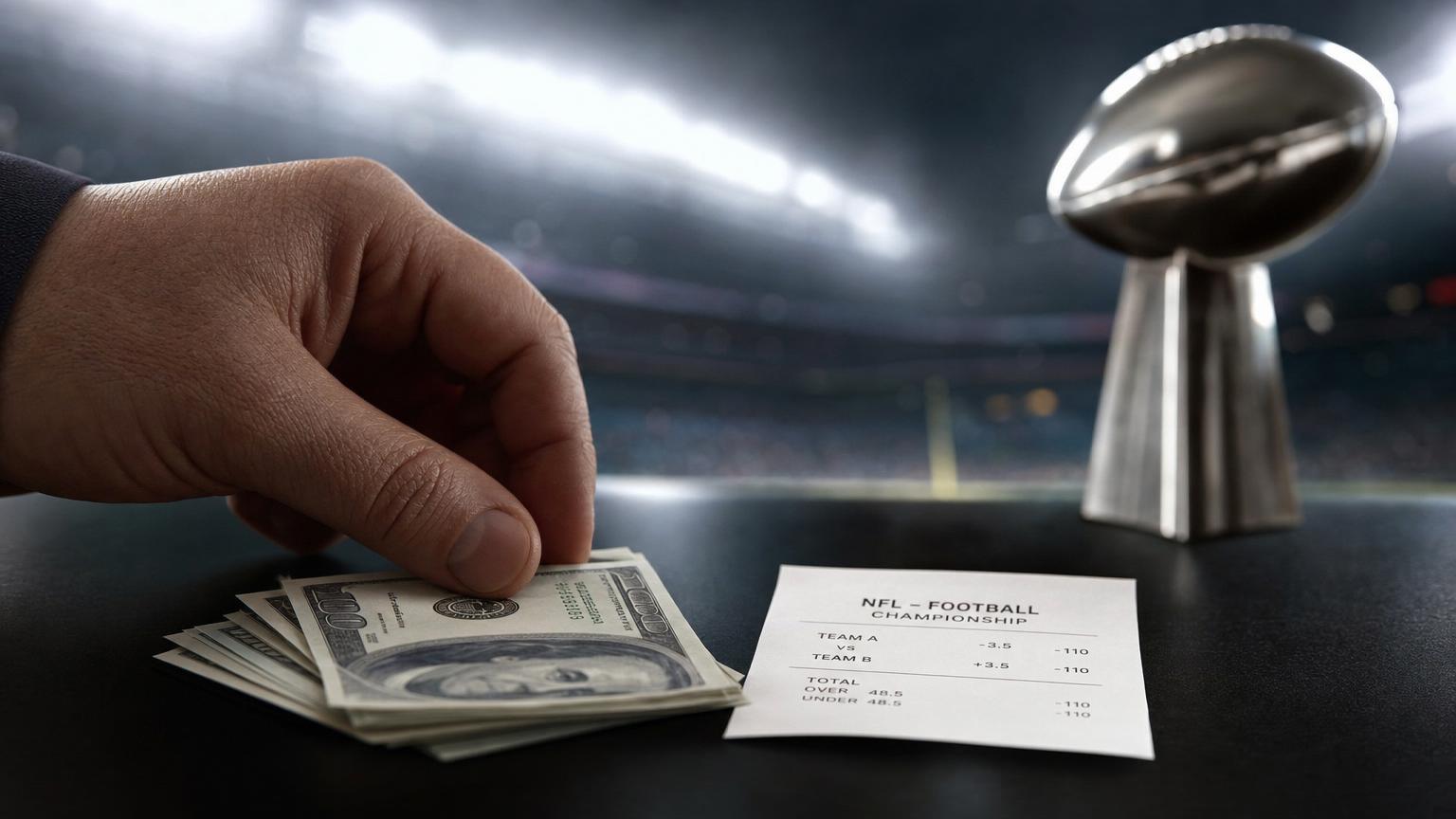
A common Super Bowl spread or total is posted at -110 on both sides. That means a bettor risks $110 to win $100, whether taking Team A or Team B. For more context on markets and prices, see how Super Bowl lines are built.

To convert -110 into implied probability, use:

110 ÷ (110 + 100) = 52.38%

Since there are two sides, the book is not offering 50% plus 50%. It is offering:

Side Odds Implied probability
Team A -110 52.38%
Team B -110 52.38%
Total 104.76%

That extra 4.76% is the overround, or built-in cushion. In a perfectly fair coin-flip market, both sides would sit around +100, adding to 100%. At -110 each way, the sportsbook can take balanced action and still have an edge over time.

<!– wp:eggb/callout {"callout_type":"tip","label_type":"","title":"Promos do not erase the price","body":"

Offers can improve a betting account’s starting position, such as get up to $3,000 Welcome Bonus at BetUS sportsbook. Still, odds should be judged separately from bonus value, since rollover rules and market vig are different things.

“,”variant”:”default”} /–>
Payout math

What vig changes on a $100 Super Bowl bet

Vig is easiest to feel in the payout, not the formula. With a $100 stake, two Super Bowl bets can look almost identical on the field but return noticeably different amounts because the price has moved.

For example, a point spread at -110 pays $90.91 profit on a $100 winning bet, for a total return of $190.91. If another book offers the same spread at -105, the profit rises to $95.24. At +100, the same $100 stake wins $100.

Super Bowl price $100 profit if it wins Total return
-115 $86.96 $186.96
-110 $90.91 $190.91
-105 $95.24 $195.24
+100 $100.00 $200.00
+105 $105.00 $205.00

That difference matters most when the handicap is the same. A bettor taking Chiefs -2.5 at -115 needs the same game result as Chiefs -2.5 at -105, but accepts $8.28 less profit per $100 won. Over many bets, that gap is the vig turning into real money.

The same idea applies to moneylines and totals. A Super Bowl over 48.5 at -120 is more expensive than over 48.5 at -105, even though the score requirement has not changed. Better pricing does not guarantee a winning bet, but it lowers the break-even point.

Promos can help with bankroll flexibility, though they do not erase the underlying price. For instance, eligible players can get up to $3,000 Welcome Bonus at BetUS sportsbook, subject to the offer’s rules and wagering terms.

Where vig tends to be heaviest

Super Bowl vig is usually easiest to spot in the main markets. Point spreads and totals often sit near the familiar -110/-110 structure, though popular numbers can move to -115 or -120 before the line itself changes. Moneylines vary more because the favorite-underdog gap changes with team strength and public demand.

Props are a different story. Player props, novelty props, and same-game-style markets often carry wider margins because pricing is harder and recreational action is heavier. A coin toss prop may look simple, but if both sides are priced at -105 or worse, the edge is still built in.

Futures can carry some of the biggest margins, especially when many teams or outcomes remain available. A Super Bowl winner board with 20-plus choices may look generous because of long odds, but the combined implied probabilities can climb far above 100%.

Checking historical Super Bowl lines and prices can help show where margins were tighter or wider in past markets. Promotions also matter separately from vig; for example, eligible new customers may get up to $3,000 Welcome Bonus at BetUS sportsbook, subject to terms.

Why break-even matters more than being right once

Vig turns a betting opinion into a math problem. A wager can cash and still be a poor long-term decision if the price demands a win rate the bettor cannot realistically sustain.

At -110, the break-even point is about 52.38%. That means a bettor picking Super Bowl sides at -110 must win more than 52.38% of those bets just to move ahead over time. At -120, the required rate climbs to 54.55%. The team may still be the correct pick, but the price can make the bet unattractive.

Expected value, or EV, compares the chance of winning with the payout offered. If a bettor estimates a team has a 55% chance to cover but the sportsbook price implies 56%, the wager is negative EV even if the team looks strong. This is where break-even win rate calculations become more useful than simply asking which side will win.

A simple habit helps: convert the odds into the needed win rate before placing the bet. If that rate feels higher than the bettor’s honest confidence level, passing may be the sharper play. Promotions can change the effective price, too; for example, bettors may see offers such as get up to $3,000 Welcome Bonus at BetUS sportsbook, but bonus terms should be checked separately from the odds themselves.

<!– wp:eggb/step-list {"section_label":"Price check","title":"A quick way to spot an expensive Super Bowl market","steps":[{"title":"Convert every price to implied probability","description":"

For negative odds, divide the price by price plus 100. For positive odds, divide 100 by odds plus 100. -120 becomes 54.55%; +110 becomes 47.62%.

“},{“title”:”Add both sides in a two-way market”,”description”:”

If Chiefs -120 and 49ers +110 total 102.17%, the extra 2.17% is the built-in margin. A higher total usually means a more expensive bet.

“},{“title”:”Sum the whole futures board”,”description”:”

For Super Bowl winner markets, convert every team and add the percentages. A board totaling 118% is much heavier than one at 110%, even if the favorite looks similar.

“},{“title”:”Normalize the prices for a fair estimate”,”description”:”

Divide each team’s implied probability by the market total. On a 118% board, a team listed at 20% is closer to 16.95% after removing vig.

“},{“title”:”Compare the same pick across books”,”description”:”

The best price matters more than the logo on the page. Line shopping also pairs well with reading handle and ticket splits for vig clues when markets move.

“}],”note”:”

Bonus offers can add value, but the posted odds still decide the bet’s expected return.

“,”toc_label”:”Price check”,”variant”:”checklist”,”anchor”:”price-check”,”include_in_toc”:true,”level”:2} /–> <!– wp:eggb/callout {"callout_type":"tip","label_type":"","title":"Do not let a promo hide a bad number","body":"

A sportsbook may advertise perks such as get up to $3,000 Welcome Bonus at BetUS sportsbook, but the market math should still come first. A +120 futures price at one book can be weaker than +140 elsewhere, even before bonus terms, rollover rules, or eligible markets are considered.

“,”variant”:”default”} /–>

Why Super Bowl odds move before kickoff

Super Bowl lines can move for several reasons, and not every move means the sportsbook has changed its opinion on the true margin. A spread shifting from -2.5 to -3 may reflect fresh information, but a price changing from -110 to -120 can simply be the book making one side more expensive while holding the number steady.

The cleanest moves usually follow new information: confirmed injuries, weather updates for outdoor venues, lineup changes, or coaching news. Star-player uncertainty is especially tricky because books may shade prices before anything is official, anticipating how bettors will react. For a closer look at that dynamic, see how injury news can affect payouts.

Other moves are driven by the market itself:

  • Public demand: popular teams and star quarterbacks can attract recreational money, especially closer to kickoff.
  • Sharp action: respected bettors may force a quick adjustment, even with smaller bet volume.
  • Risk balancing: a book may move odds to limit exposure, not because its projection changed.
  • Promotional traffic: offers such as get up to $3,000 Welcome Bonus at BetUS sportsbook can bring more betting activity, though bonus terms matter separately from the odds.

The practical takeaway: track both the line and the price. A half-point move and a vig adjustment are different signals.

Using closing line value as a price check

Closing line value compares the odds taken on a bet with the odds available near kickoff. If a Super Bowl side was bet at +120 and closed at +105, the ticket beat the final market price, regardless of whether the team won. That does not prove the pick was “right,” but it suggests the bettor captured a better number than late buyers.

This matters because vig makes small price differences meaningful over time. A bettor can calculate closing line value by comparing implied probabilities at the original and closing prices, then noting whether the earlier wager had the lower break-even point.

Promos can change the practical cost of entry, too; for example, eligible players may get up to $3,000 Welcome Bonus at BetUS sportsbook. Still, CLV is mainly a market-quality check, not a scoreboard judgment.

Bonus math

Promotions can help, but terms decide the value

Sportsbook promos can soften the cost of vig, especially around a high-volume event like the Super Bowl. A deposit offer, odds boost, free bet, or site credit may turn a marginal price into a playable one, but only after the fine print is priced in.

For example, bettors can get up to $3,000 Welcome Bonus at BetUS sportsbook, which may look powerful next to a standard point spread or moneyline. The real value still depends on the rules attached to the offer:

  • Rollover: how many times bonus funds must be wagered before withdrawal.
  • Eligible markets: whether Super Bowl props, futures, or live bets count.
  • Minimum odds: whether short favorites qualify.
  • Payout treatment: whether stakes, bonus funds, or only winnings are returned.

A promo offsets vig only when its expected value survives those conditions.

<!– wp:eggb/callout {"callout_type":"tip","label_type":"","title":"Price the bonus like a bet","body":"

A larger bonus is not automatically better. Compare the required wagering, eligible odds, and cashout rules against the sportsbook’s posted prices before treating any promotion as real edge.

“,”variant”:”default”} /–> <!– wp:eggb/conclusion {"section_label":"Final check","title":"A smarter last look before betting","points":[],"summary":"

Before a Super Bowl bet is placed, the market deserves one quick audit: convert the odds to implied probability, compare the same wager at several sportsbooks, note whether it is a prop or futures market with naturally wider margin, then calculate the break-even rate. That routine often shows whether a price is genuinely playable or just looks attractive on the screen.

\n

Vig is part of sportsbook pricing, so it cannot be removed entirely. The goal is to avoid paying more than necessary. Promotions can help when the terms fit the wager; for example, players can get up to $3,000 Welcome Bonus at BetUS sportsbook, but the bonus still needs to be judged by rollover rules, eligible markets, and the final price offered.

“,”toc_label”:”Final betting check”,”variant”:”default”,”heading_tag”:”h2″,”anchor”:”final-betting-check”,”include_in_toc”:true,”level”:2} /–>
Andy
Andy
Hi I'm Andy and as a regular bettor on sports I know where to spot a good sportsbook sign up deal. With over 25 years of placing wagers on sports betting including NFL, horse racing and soccer I can lend my expertise to writing and advising you on everything sports and NFL betting. To your success.

1 comment on “How Does Vig Affect Super Bowl Odds and Your Expected Payouts

On the -110/-110 example, is the 104.76% overround basically the same idea for Super Bowl props with more than two outcomes, just uglier math?

Like if I’m looking at first TD scorer or MVP futures, do I just convert every single price to implied probability and add them up? Feels like those markets are where the book quietly turns the “vig dial” up to 11.

Add a Comment