
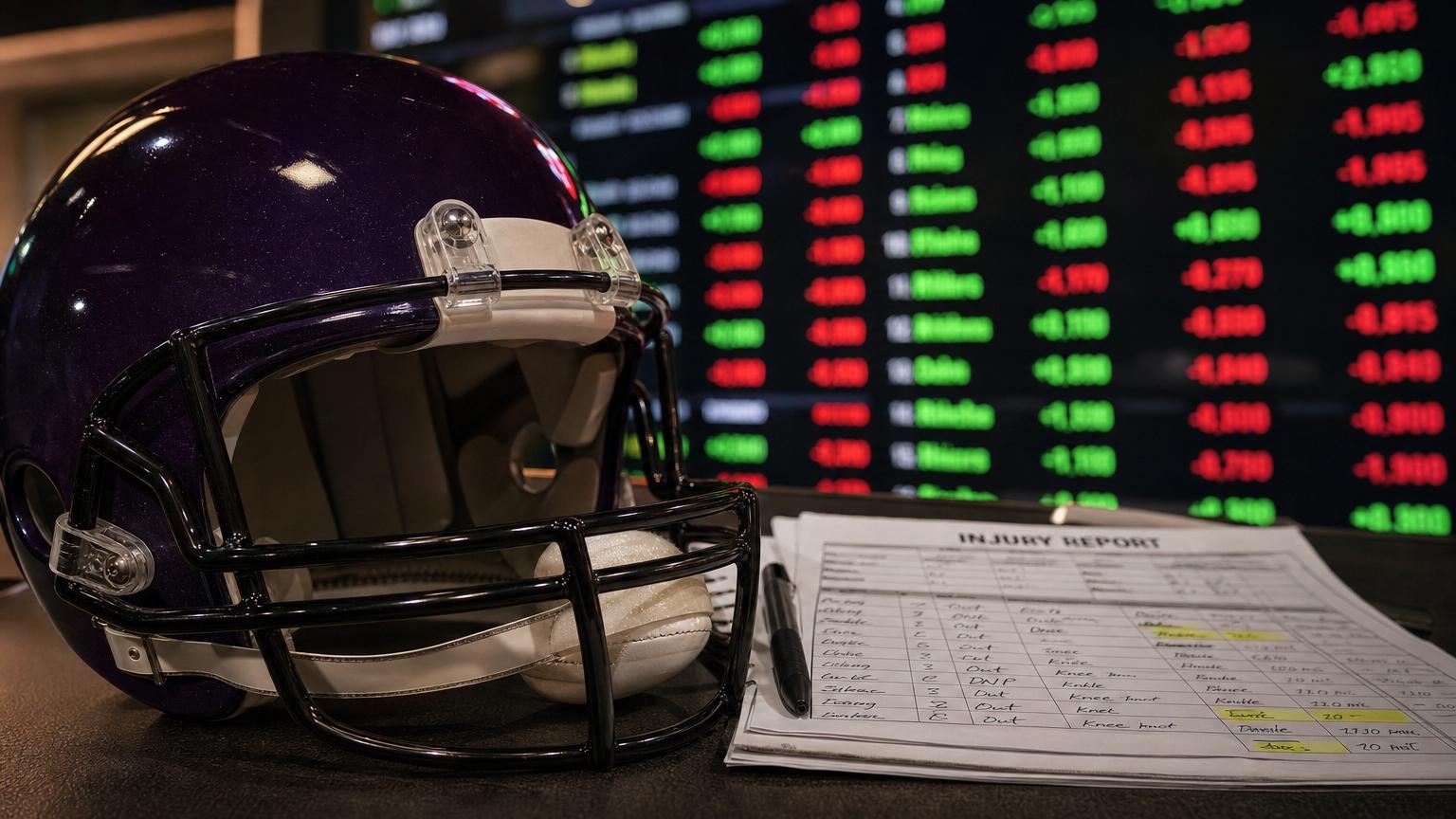
For a few seconds, the futures board may know less than the television audience.
A quarterback stays down after a blind-side hit, and the broadcast cuts to trainers while the championship market still lists his team at +900. That stale-looking number can feel like a brief edge. But tapping it is not the same as securing it: the sportsbook may suspend the market, refresh the price, lower the stake limit, or reject the ticket before confirmation.
Top NFL Offshore Sportsbooks for October 2026

BetUS

BetNow

MyBookie

Bet105

BUSR Sports

Everygame Sports

BetOnline

BetWhale

BetAnything

Xbet

Bovada

Bookmaker
The only price that matters is the one shown on the accepted bet slip. Even a chance to get up to $3,000 Welcome Bonus at BetUS sportsbook does not make an unconfirmed futures quote real. In this window, seconds matter—but acceptance matters more.
The three clocks that matter
Super Bowl futures are long-term bets on a team to win the championship. Their prices reflect implied probability, sportsbook liability, and the cost of tying up money until the season ends. A primer on Super Bowl futures and post-injury movement helps put each adjustment in context.
Three separate clocks determine how quickly the market reacts:
- Suspension clock: A sportsbook removes the team’s futures once credible information suggests the injury could materially affect its chances.
- First-revision clock: The book reposts odds after estimating the player’s absence, replacement quality, schedule, and playoff outlook.
- Consensus clock: Competing sportsbooks settle into a similar range as medical reporting becomes clearer and sharper bettors test the new prices.
Timing should begin with credible injury information—an official team announcement, trusted reporter, or confirmed diagnosis—not the play itself or an unverified social post. A player may look seriously hurt yet miss little time, while a less dramatic injury can prove season-ending.
Promotions do not make stale odds dependable. For example, bettors can get up to $3,000 Welcome Bonus at BetUS sportsbook, but the wager still depends on the price available when the ticket is accepted.
Estimate how much the injury matters
A useful estimate starts with football impact, not the size of the headline. Score each injury against five practical factors:
- Position: Quarterbacks usually move futures most; elite pass rushers, tackles, and coverage players can also matter.
- Expected absence: One missed game rarely equals a season-ending loss.
- Backup quality: A proven reserve limits the downgrade; a steep drop-off magnifies it.
- Schedule: Difficult opponents during the absence increase the likely standings damage.
- Playoff position: A bubble team has less room for error than a division leader with tiebreaker advantages.
Next, compare the current price with the pre-injury number. A move from +800 to +1000 may already capture much of the expected damage, leaving little value in reacting late. The effect of early losses and injuries on futures value also depends on whether the team still has time to recover in the standings.
Promotions such as get up to $3,000 Welcome Bonus at BetUS sportsbook should be evaluated separately from the underlying futures price and applicable terms.
A confirmed long-term loss to an irreplaceable starter deserves more weight than vague “questionable” reporting. If odds moved before confirmation, the market may have already priced in the most likely outcome.
Follow the repricing sequence
A credible injury report often prompts a sportsbook to suspend Super Bowl futures before deciding the exact adjustment. During that pause, displayed odds may remain visible, but wager attempts can be rejected or held for review.
The usual sequence looks like this:
- Suspension: The book stops new bets while confirming the report and estimating the player’s value.
- Cautious reopening: The affected team returns at a shorter betting limit or a less attractive price. Limits may stay low while uncertainty remains.
- Broader adjustment: Division rivals, conference contenders, and other likely beneficiaries move at the same time.
- Market alignment: Competing books react, and prices gradually settle into a narrower range as information becomes widely accepted.
Those related moves help explain how sportsbooks reprice teams after injuries. If one contender weakens, its direct rivals may shorten even when nothing has changed on their own rosters.
A rejected wager or changing checkout price is evidence of active repricing, not proof that stale odds were available. The price shown on a screen is less important than the price accepted on the final ticket.
Eligible new customers can get up to $3,000 Welcome Bonus at BetUS sportsbook, but promotional value should be assessed separately from whether an injury-adjusted futures price is competitive.
Set realistic expectations for the next price
-
First 0–2 minutes: markets may disappear
Automated alerts or a sudden broadcast report can trigger an almost immediate suspension, especially during high-traffic hours.
-
Next 2–15 minutes: the first number appears
A book may reopen with a cautious price, lower limits, or a wider margin while traders assess the source.
-
Within 15–60 minutes: active books react
Liquid markets move faster because wagers reveal demand. Overnight news or lightly traded futures may receive slower attention.
-
Over 1–6 hours: uncertainty gets priced
Conflicting reports, unclear recovery timelines, and disagreement over a replacement can produce several revisions rather than one clean move.
-
By the next day: diagnosis drives consensus
An MRI result, team statement, or credible recovery estimate usually narrows differences, though books can still disagree on the player’s value.
Injury repricing is usually sharper than the way draft developments affect futures odds. Draft information often accumulates over days; an injury can change availability immediately, yet medical ambiguity can keep prices moving for hours.
Eligible new customers can get up to $3,000 Welcome Bonus at BetUS sportsbook; terms, location restrictions, and wagering requirements apply.
Measure the move, not the payout
A drift from +600 to +900 looks dramatic, but converting both prices into implied probability makes the change easier to judge:
- +600: 100 ÷ (600 + 100) = 14.3%
- +900: 100 ÷ (900 + 100) = 10.0%
- Change: down 4.3 percentage points, or roughly 30% relative to the original probability
That calculation does not prove +900 is valuable. Futures prices include sportsbook margin, and the market may still be estimating the player’s recovery timeline. A larger payout can simply reflect a weaker championship outlook.
Before treating the new number as an opportunity, compare at least three books and record the timestamp of each quote. One operator may still show a stale +600, another may reopen at +750, and a faster-moving book may already post +900. The key comparison is between prices available at the same stage of the news cycle—not screenshots captured hours apart.
Also check correlated contenders. If the injured team moves from +600 to +900 while a division rival shortens from +1200 to +900, that supports a genuine redistribution of championship probability. If rivals barely move, the outlying +900 may reflect one book’s caution, exposure, or limited futures liquidity rather than consensus.
Eligible new customers may get up to $3,000 Welcome Bonus at BetUS sportsbook. Availability varies by location and age; deposit, rollover, expiration, and withdrawal terms apply. Promotional credit should never substitute for comparing prices. Gambling involves risk—set limits, wager only affordable amounts, and use local responsible-gambling support if needed.
Choose a response, not a reaction
Match action to certainty
Before betting, separate a confirmed diagnosis from sideline speculation. Waiting may surrender an attractive number, but it also avoids paying for a rumor. Acting early is most defensible when the source is credible and the available odds imply a smaller downgrade than a reasonable injury estimate.
Convert the new price to implied probability and compare it with a personal post-injury range. If the market has moved beyond that range’s pessimistic end, the team may be oversold; that can justify a modest position, not an automatic double-down. If the price sits inside the estimated range, passing is often the cleaner decision.
Manage an existing ticket
An existing future does not require immediate repair. The response should depend on exposure, conviction, and hedge cost:
- Hold when the ticket remains acceptable under the likely recovery timeline.
- Add a rival when one team benefits clearly and its price has not fully adjusted.
- Use another market, such as a conference or division future, when it offsets risk more efficiently.
- Cash out cautiously; the offered value may include a substantial sportsbook discount.
These ways to hedge after a sudden price move work best when sized as insurance rather than a chase. Promotions should not change that discipline: eligible customers can get up to $3,000 Welcome Bonus at BetUS sportsbook, but terms, rollover requirements, and limits should be checked before depositing.
Run this check before placing the bet
-
Verify the injury status
Prioritize team statements and reliable reporters over clips, rumors, or deleted posts.
-
Confirm the market is live
Check that odds are available and unchanged at the final ticket-confirmation screen.
-
Compare several books
A lone stale price is less meaningful than a move appearing across multiple sportsbooks.
-
Recalculate the price
Estimate the team’s fair probability after the injury, then compare it with the new implied probability.
-
Cap the stake
Use a small, predetermined amount; wider medical uncertainty calls for less exposure, not more.
Eligible players can get up to $3,000 Welcome Bonus at BetUS sportsbook, subject to location, eligibility, and wagering terms.
Sportsbook risk teams can respond immediately, even before a bettor sees different numbers. Visible futures odds often move within minutes, but a fuller adjustment can take hours—or wait for definitive medical news.
Uncertainty alone is not an edge. A wager makes sense only when the available price beats a defensible estimate, with stakes kept disciplined.
Top NFL Offshore Sportsbooks for October 2026
BetUS
BetNow
MyBookie
Bet105
BUSR Sports
Everygame Sports
BetOnline
BetWhale
BetAnything
Xbet
Bovada

3 comments on “How Fast Do Super Bowl Futures Move After a Major Injury?”
The “three clocks” framework actually worked for me. I saw the visible futures price sitting there after an injury alert, but instead of assuming it was available, I waited for the market to reopen and checked two other books.
By then the team had moved from +650 to +850 and its main conference rival had shortened too. Annoying that I missed the prettier number, but at least I didn’t build a whole plan around a ticket that was probably getting rejected anyway 😅
I’m still a little fuzzy on measuring agreement across books. One book reopened at +900, another was +800, and a third stayed suspended until the next morning. Does step 3 basically not work until every book is live, or is two enough to estimate the new range?
You don’t need every book to be live, but two prices alone should be treated as an early range rather than consensus. Check whether related markets moved in the same direction—especially conference odds and rival futures—and note each book’s limits and usual pricing.
Once the suspended book reopens, you’ll have a better read on whether +900 was a cautious outlier or the market’s likely destination.