
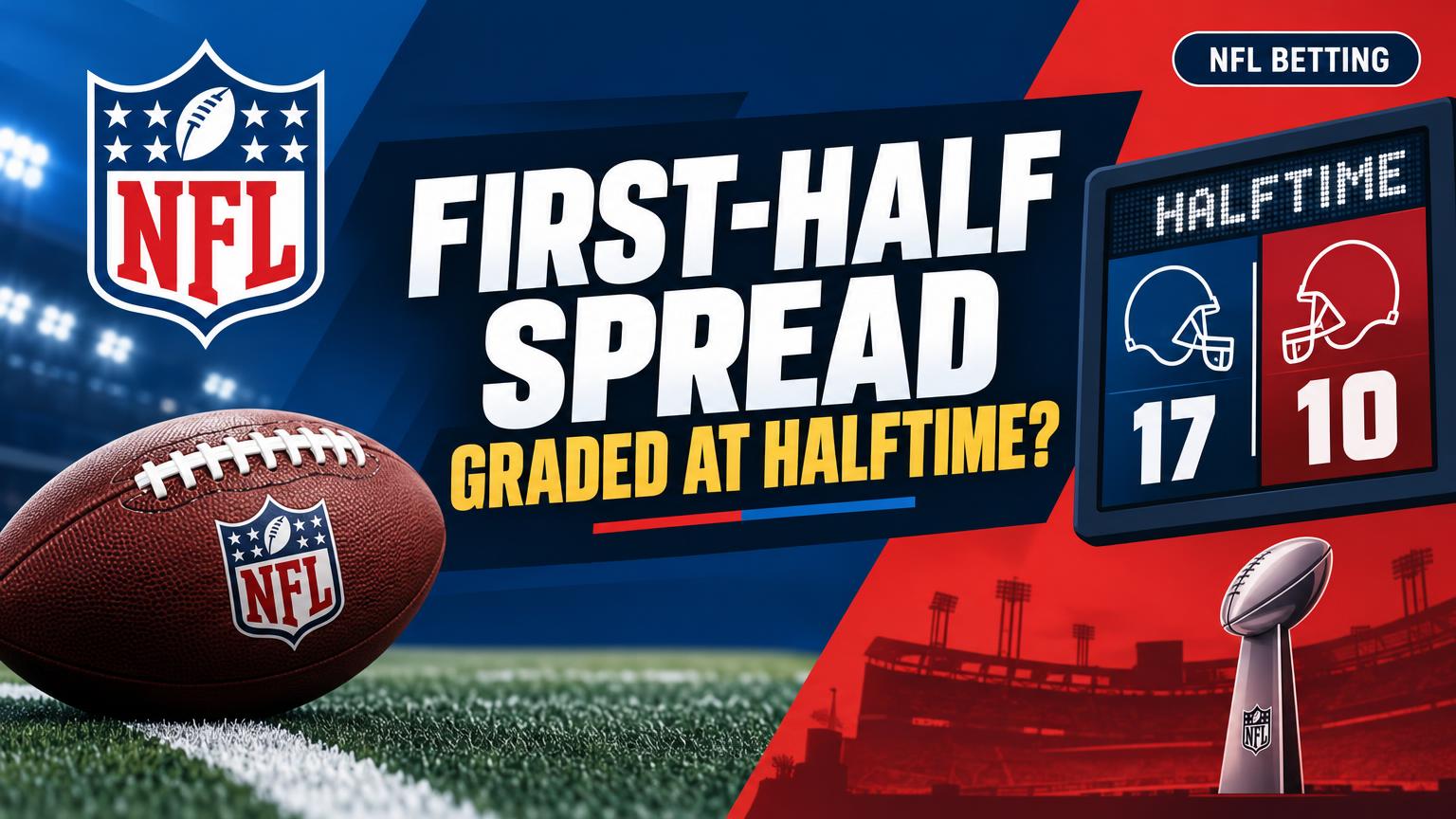
A halftime lead does not always mean a winning ticket.
The scoreboard reads 14–10 at halftime. A first-half bet on the leading team at -6.5 loses: a four-point lead does not cover the spread. The trailing team at +6.5 covers because it is behind by fewer than seven points. Only the score after the first two quarters grades the bet; a second-half comeback cannot change it. If the margin lands exactly on a whole-number spread, the result is generally a push, subject to house rules.
Top NFL Offshore Sportsbooks for November 2026

BetUS

BetNow

MyBookie

Bet105

BUSR Sports

Everygame Sports

BetOnline

BetWhale

BetAnything

Xbet

Bovada

Bookmaker
The halftime score settles the spread
A standard pregame NFL first-half spread is graded using the score when the second quarter ends. If a team leads 17–10 at halftime, it has a seven-point first-half margin. That team covers a first-half spread of -6.5, regardless of what happens after the break. The same timing rule applies across the guide to NFL period betting.
A second-half comeback cannot turn a losing first-half bet into a winner. The final score and overtime do not change the halftime calculation. When checking a result, compare the official halftime score with the first-half line on the bet slip, not the full-game spread.
For NFL and Super Bowl LXI betting, two offshore sportsbook picks are Bet105 and BetUS. Bet105 advertises up to $2,000 back in weekly loss rebates across sports and casino, with no rollover; activation is required once, after which rebates accrue automatically. BetUS advertises a 200% welcome bonus up to $1,000 with code NEW200, split into a 100% sports match up to $500 and a 100% casino match up to $500. Bonus terms can change.
How to calculate the first-half spread result
-
Start with the official halftime score
Record the selected team’s points and its opponent’s points at the end of the second quarter. The final game score does not enter this calculation.
-
Find the selected team’s signed spread
Keep the minus or plus sign shown on the first-half bet. For example, a favorite might be listed at −7.5, while the underdog is listed at +7.5.
-
Add the spread to the selected team’s score
If the favorite leads 17–10 at halftime, its adjusted score at −7.5 is 9.5. The minus sign makes a seven-point lead insufficient: the favorite needs to lead by at least eight. The underdog, down 10–17 at +7.5, has an adjusted score of 17.5; the plus sign lets it cover while trailing by seven.
-
Compare the adjusted score with the opponent’s score
An adjusted score above the opponent’s score wins the spread bet; one below it loses. In the examples above, the −7.5 favorite loses and the +7.5 underdog wins.
-
Check for an exact tie
With a whole-number spread, the adjusted scores can match. A 17–10 favorite at −7 finishes at 10–10 after the adjustment, generally grading as a push.
Three halftime spread examples
Each example grades a bet on the named team using only the score at halftime. The signed spread is added to that team’s points, not to the opponent’s.
- Favorite covers — Chiefs -6.5: The original halftime score is Chiefs 17, Raiders 10. Adding the -6.5 spread gives the Chiefs an adjusted score of 10.5, still above the Raiders’ 10. Result: Chiefs -6.5 wins.
- Trailing underdog covers — Bears +6.5: The original halftime score is Bears 13, Lions 17. Adding the +6.5 spread gives the Bears an adjusted score of 19.5, above the Lions’ 17. Result: Bears +6.5 wins, despite the Bears trailing at halftime.
- Halftime leader fails to cover — 49ers -6.5: The original halftime score is 49ers 14, Rams 10. Adding the -6.5 spread leaves the 49ers with an adjusted score of 7.5, below the Rams’ 10. Result: 49ers -6.5 loses, despite the four-point lead.
For NFL and Super Bowl LXI betting, offshore sportsbook picks include Bet105 and BetUS. Bet105 offers up to $2,000 back in weekly loss rebates across sports and casino, with no rollover; the offer is activated once and then earns automatically. BetUS advertises a 200% Welcome Bonus up to $1,000 with code NEW200: a 100% sports match up to $500 and a 100% casino match up to $500. Offer terms can change.
What happens when the spread lands exactly?
Suppose a favorite leads 17–10 at halftime and was listed at -7 for the first half. Subtracting seven points from its score produces a 10–10 adjusted tie. That is a push: a straight bet usually has its stake returned rather than recording a win or loss, subject to the sportsbook’s house rules. Parlays and promotions may handle pushes differently.
A half-point spread removes that exact-tie possibility because NFL scores are whole numbers. With the same 17–10 halftime score, the favorite covers -6.5 but loses at -7.5. The actual margin has not changed; only the number it must beat has.
Covering and payout are separate questions. The spread determines whether the bet wins, loses, or pushes; the odds determine the return on a winning bet. An alternate line can make a cover easier or harder while changing the quoted odds, so the price of alternate first-half spreads matters alongside the new threshold. The halftime score still decides the result, regardless of the final score.
When does a first-half spread settle?
A first-half spread is normally graded once the halftime score is confirmed. The sportsbook may still take time to update the account: a ticket marked “pending” shortly after halftime does not necessarily mean the second half matters. The grading result is based on the first-half margin, not on when the balance changes.
An interruption makes the distinction more important. If play is suspended before the first half is complete, there may be no confirmed halftime score to grade. If a game is abandoned, or an official score correction changes the recorded first-half points, the outcome can depend on the sportsbook’s rules for that market. There is no reliable one-size-fits-all assumption that every such ticket wins, loses, or is voided.
For an unusual result, the useful checks are the book’s first-half settlement rules, the official halftime score, and the status shown on the settled ticket. A pending ticket and a graded ticket are not the same thing.
A delayed account update is different from a changed result. If the posted grade appears inconsistent with the confirmed halftime score, the ticket details and the sportsbook’s market rules provide the clearest starting point.
Check the market before grading
The same halftime score can produce different results depending on the market printed on the ticket. Check the period, bet type, and selected side before comparing scores. A first-half spread is usually marked “1H” or “First Half,” alongside a team and a number such as −3.5.
A second-quarter spread uses only points scored in the second quarter, not the entire first half. A full-game spread uses the final score, subject to the sportsbook’s overtime rules. A first-half total adds both teams’ halftime points and compares that sum with the posted over/under number; it does not measure either team’s winning margin.
A first-half moneyline asks which team leads at halftime, with no point adjustment. That distinction matters when choosing between a first-half spread and moneyline: a team can lead at the break yet fail to cover its first-half spread.
How is a first-half over-under graded?
Add both teams’ halftime points and compare the sum with the posted total; neither team’s score is adjusted. At 17–10, the combined 27 points beat an over 26.5 bet.
Why doesn’t the total use the spread?
A spread measures an adjusted scoring margin; a total measures combined points. First-half over-under line comparisons show how a different posted total changes the result.
How does a first-half moneyline differ?
The moneyline backs the team ahead at halftime, with no point adjustment. A 14–13 leader wins its first-half moneyline but fails to cover -3.5.
What if the combined score equals the total?
A whole-number total generally pushes when the halftime points match it exactly. Half-point totals avoid a tie.
Sportsbook offers and halftime grading
An NFL first-half spread is graded from the halftime score, regardless of which sportsbook takes the bet. A welcome bonus or rebate may affect a qualifying account’s promotional balance, but it does not change whether a first-half spread wins, loses, or pushes.
Two offshore sportsbooks advertise offers that may be of interest for NFL betting, including Super Bowl LXI:
- Bet105 advertises up to $2,000 in weekly loss rebates across sports and casino, with no rollover. The offer requires a one-time activation; eligible rebates then accrue automatically under its terms.
- BetUS advertises a 200% welcome bonus of up to $1,000 with code NEW200. That total consists of a 100% sports match up to $500 and a separate 100% casino match up to $500—not a 200% match on sports bets alone.
These are advertised promotions, not grading rules. Offer details can change, and the sports and casino portions may have different eligibility requirements.
Before considering an NFL or Super Bowl LXI wager, check sportsbook availability in the bettor’s location, account eligibility, and the current terms for the specific promotion and bet.
-
Check the ticket
Confirm it says NFL first-half spread; note the selected team and signed line.
-
Record halftime
Use the official score at the end of the second quarter, not the final score.
-
Apply the spread
Add the signed line to the selected team’s halftime points.
-
Compare the scores
A higher adjusted score wins; equal scores push. If the grade differs, check the sportsbook’s first-half settlement rules and ticket record.
For NFL and Super Bowl LXI, offshore picks Bet105 and BetUS advertise bonuses. Bet105 offers up to $2,000 in weekly sports-and-casino loss rebates with no rollover; activate once to earn automatically. BetUS offers a 200% welcome bonus up to $1,000: a 100% sports match and a 100% casino match, each up to $500, with code NEW200. Terms apply.
Top NFL Offshore Sportsbooks for November 2026
BetUS
BetNow
MyBookie
Bet105
BUSR Sports
Everygame Sports
BetOnline
BetWhale
BetAnything
Xbet
Bovada
