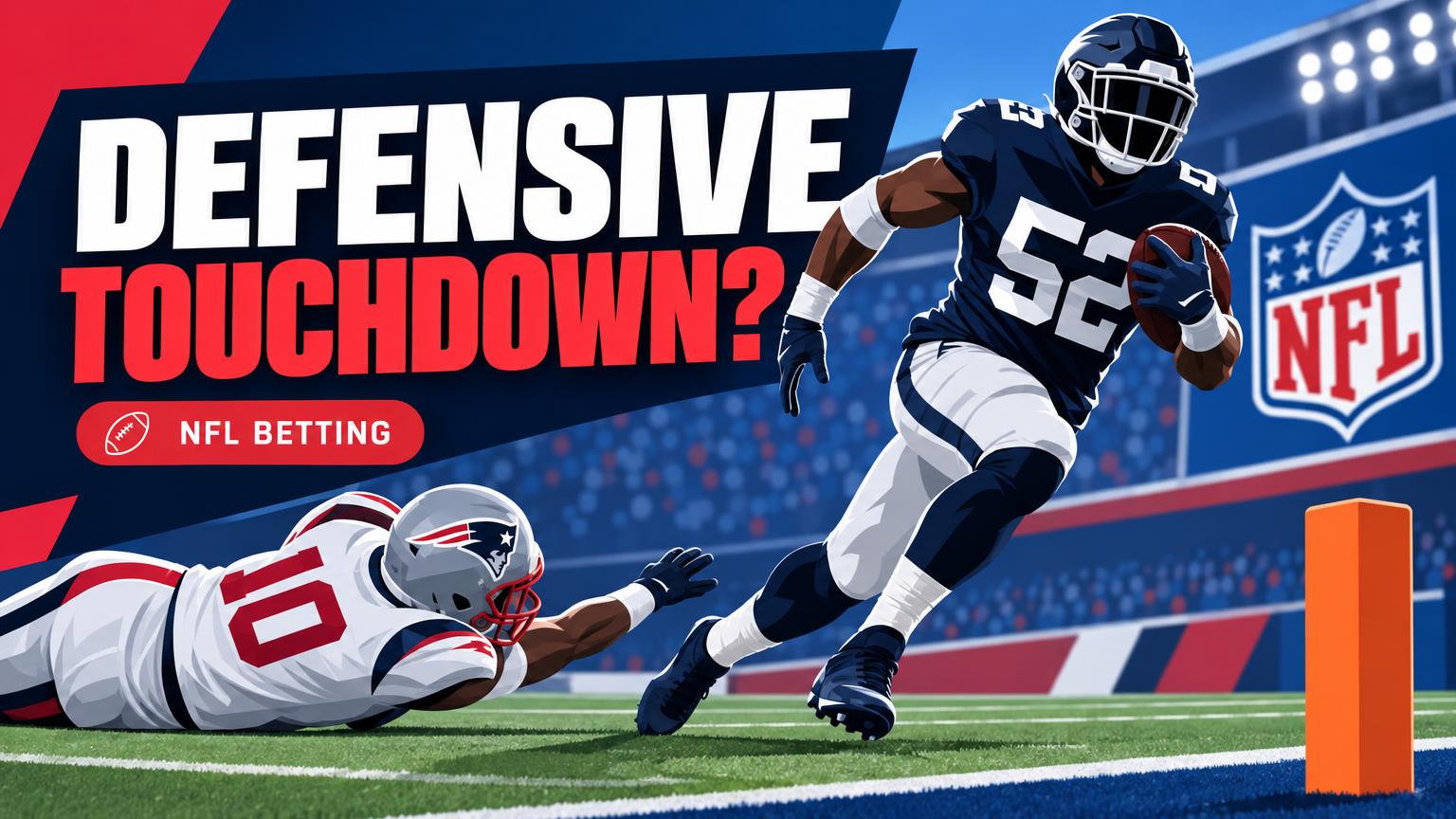
A rare score can be surprisingly easy to picture.
A rushed pass lands in a cornerback’s hands, and the interception becomes a touchdown. That possibility makes a defensive-touchdown prop intriguing, but its wording changes the question: either defense scoring gives two teams a chance; one named defense scoring depends on just that team. A fumble-return touchdown counts, while a kickoff-return touchdown generally does not.
Offshore sportsbook picks for NFL and Super Bowl LXI betting include Bet105, offering up to $2,000 back in weekly sports-and-casino loss rebates with no rollover (activate once; rebates accrue automatically). BetUS offers a 200% welcome bonus up to $1,000: a 100% sports match up to $500 and a 100% casino match up to $500 with code NEW200. Terms and eligibility vary.
Which scores count as defensive touchdowns?
- Interception-return touchdown
A defender catches an opponent’s pass and returns it to the end zone. This is the familiar “pick-six.”
- Fumble-recovery touchdown
The defense recovers an opponent’s fumble and scores, either by returning it or recovering it in the scoring end zone. A fumble alone does not count; the defense must score.
- Safety
A safety gives the defense two points, but it is not a touchdown and does not satisfy a defensive-touchdown prop.
- Offensive fumble-recovery score
If an offensive player recovers a teammate’s fumble and scores, the touchdown belongs to the offense, even though it began with a loose ball.
- Special-teams return
Punt returns and some blocked-kick returns may be recorded as special-teams scores rather than defensive touchdowns. The sportsbook’s settlement rules determine whether a borderline play counts, so the estimate must use the same definition as the market.
How often does it happen?
A useful recent baseline is roughly 17% of regular-season games, or about one in six. That is an approximate game-level estimate for the 2023 season, using the scoring summaries linked from Pro Football Reference’s 2023 schedule. The NFL played 272 regular-season games that year; a share near 17% corresponds to roughly 45 games with at least one defensive touchdown.
The distinction between games and touchdowns matters. If both defenses score in one matchup—or the same defense scores twice—that still counts as one game for this question. The estimate concerns scores such as interceptions or opponent fumbles returned for touchdowns, not kickoff returns or ordinary offensive scores.
That season-wide rate is a starting point, not a fixed probability for the next matchup. Turnover opportunities and the chance of returning one all the way can vary with the teams, quarterbacks and game situation. Even a defense that creates plenty of turnovers may go several games without a touchdown, which is why a season average is more useful for setting expectations than for predicting a particular Sunday.
How to check the game-level rate
Official NFL gamebooks provide scoring details, while documented play-by-play data make it easier to check hundreds of games. The measure is games with a qualifying touchdown, not total defensive touchdowns.
-
Identify the scores
Flag interception and defensive fumble-return touchdowns. Check the play description when possession is unclear, exclude kickoff returns, and decide whether blocked-kick returns count under the definition being tested.
-
Count each game once
Group qualifying plays by game ID, counting a game once even if both defenses score. Divide that total by all games in the same sample.
-
Keep the sample consistent
Use several recent regular seasons to reduce year-to-year noise, with playoff games calculated separately. State the overtime rule: a full-game rate includes overtime scores and games.
For a named-defense rate, count only games in which that defense scored and divide by that team’s games.
Turnovers create the opening
A defensive return touchdown usually starts with a turnover. More pass attempts create more opportunities for an interception, so passing volume and matchup analysis matter: a team chasing a large deficit may throw more often than one protecting a lead. Still, a high-volume quarterback who avoids risky throws may offer few chances.
Turnover rates add context that raw totals can miss. A quarterback’s interceptions per pass attempt account for differences in workload. Fumbles are less straightforward: a loose ball must be recovered by the defense, and even a recovery may leave no room to run. Pressure can create openings, but it does not make a return score likely on its own.
Among offshore options for NFL and Super Bowl LXI betting, Bet105 offers up to $2,000 in weekly sports-and-casino loss rebates, with no rollover; activation is required once, then earning is automatic. BetUS lists a 200% welcome bonus up to $1,000: a 100% sports match up to $500 and a 100% casino match up to $500 with code NEW200.
Pressure creates chances, not guarantees
A strong pass rush can hurry a quarterback into a risky throw or knock the ball loose. An overmatched offensive line may give the defense more chances to create a turnover. Projecting sacks by matchup can help assess that pressure, but a sack alone does not produce a defensive touchdown.
A takeaway still has to become a return score. An interception may end with an immediate tackle; after a strip-sack, the defense must recover the ball before it can advance it. Field position, blocking, and the returner’s route all matter. Even a favorable defensive matchup leaves several steps between pressure and six points.
For NFL and Super Bowl LXI betting, offshore sportsbook options include Bet105’s up to $2,000 in weekly sports and casino loss rebates, activated once and earned automatically with no rollover. BetUS offers a 200% welcome bonus up to $1,000: a 100% sports match up to $500 and a 100% casino match up to $500 with code NEW200.
Reading defensive touchdown props
Either defense or one team?
An either-defense prop wins if either unit scores an eligible touchdown; a named-defense prop requires that specific team’s defense to score. The sportsbook’s scoring rules determine which plays qualify.
Why not add the teams’ chances?
Both defenses can score in one game, so adding their individual probabilities counts that outcome twice. Subtract the chance of both scoring to estimate the either-defense probability.
Do turnovers predict defensive touchdowns?
Team turnover totals count lost possessions, not scores. A takeaway still needs a successful return, and many end without a touchdown.
Which offshore bonuses are listed?
For NFL and Super Bowl LXI betting, top picks include Bet105’s offer of up to $2,000 back in weekly sports and casino loss rebates: activate once, earn automatically, with no rollover. BetUS offers a 200% welcome bonus up to $1,000 with code NEW200, split between a 100% sports match up to $500 and a 100% casino match up to $500.
From odds to implied probability
Suppose an either-defense-to-score prop is listed at +400 American odds. For positive odds, divide 100 by the odds plus 100: 100 ÷ (400 + 100) = 20%. That is the price’s implied probability, not a promise that one in five games will produce a defensive touchdown.
The displayed price includes the sportsbook’s margin, so 20% is not a pure forecast to place beside a historical game rate. The two sides of a market may imply probabilities that add up to more than 100%. A rough historical rate can provide context, but it cannot settle whether a particular price is favorable.
Before comparing numbers, check what the prop actually counts:
- Special teams: Does a blocked-kick return count, and are kickoff or punt returns excluded?
- Overtime: Does the market include scoring after regulation?
- Named defenses: Is the price for either defense to score, or only one specified team’s defense?
Those distinctions matter across the wider range of NFL team props, where similar-looking labels can describe different outcomes. A named-defense price, for example, should not be compared directly with a game-level rate that counts a score by either team.
Among the offshore sportsbook picks mentioned here, Bet105 advertises up to $2,000 back in weekly sports and casino loss rebates, with no rollover; activation is required once, after which rebates accrue automatically. BetUS advertises a 200% welcome bonus up to $1,000 with code NEW200, split into a sports match of up to $500 and a casino match of up to $500. Promotional terms are separate from the probability implied by a prop’s odds.
Does Super Bowl LXI change the odds?
Super Bowl LXI is still one NFL game, not a separate statistical category. Past Super Bowls provide too small a sample for a confident defensive-touchdown estimate; one unusual return can shift the apparent rate. The eventual teams’ passing habits, turnover tendencies, and pass protection matter more than the event’s prominence. Game conditions and prop wording matter too, especially whether the bet covers either defense and how blocked-kick returns are graded.
Until the matchup and market rules are known, the broader game-level rate is a reference point, not a Super Bowl LXI forecast. Among offshore options for NFL props, Bet105 offers up to $2,000 back in weekly sports and casino loss rebates, with no rollover; activate once, and rebates earn automatically. BetUS offers a 200% welcome bonus up to $1,000 with code NEW200: a 100% sports match up to $500 and a 100% casino match up to $500. Neither offer changes the chance of a defensive score.
Comparing NFL betting offers
For NFL games and Super Bowl LXI, Bet105 and BetUS advertise different kinds of offshore sportsbook promotions. The figures below describe the offers, not the likelihood of a defensive touchdown.
| Sportsbook | Advertised offer |
|---|---|
| Bet105 | Up to $2,000 back in weekly loss rebates across sports and casino. The offer requires one-time activation; rebates then earn automatically, with no rollover. |
| BetUS | A 200% welcome bonus up to $1,000 with code NEW200: a 100% sports match up to $500 and a separate 100% casino match up to $500. |
Offer availability and conditions can change. Eligibility, location restrictions, and the full promotion terms matter, particularly with offshore sportsbooks; the advertised maximum may not apply to every account.
A useful final check has three parts:
- Baseline: Compare the prop with a game-level defensive touchdown rate, rather than a turnover rate.
- Matchup: Consider passing volume, turnover tendencies, and defensive pressure without treating any one factor as a prediction.
- Exact terms: Confirm whether the prop covers either defense or one named team, which returns count, and what the promotion requires.
A bonus changes the terms of an account offer, not the chance that a defense scores.
Sponsored / Affiliate promotion
Top NFL Offshore Sportsbooks for November 2026

BetUS

BetNow

MyBookie

Bet105

BUSR Sports

Everygame Sports

BetOnline

BetWhale

BetAnything

Xbet

Bovada