
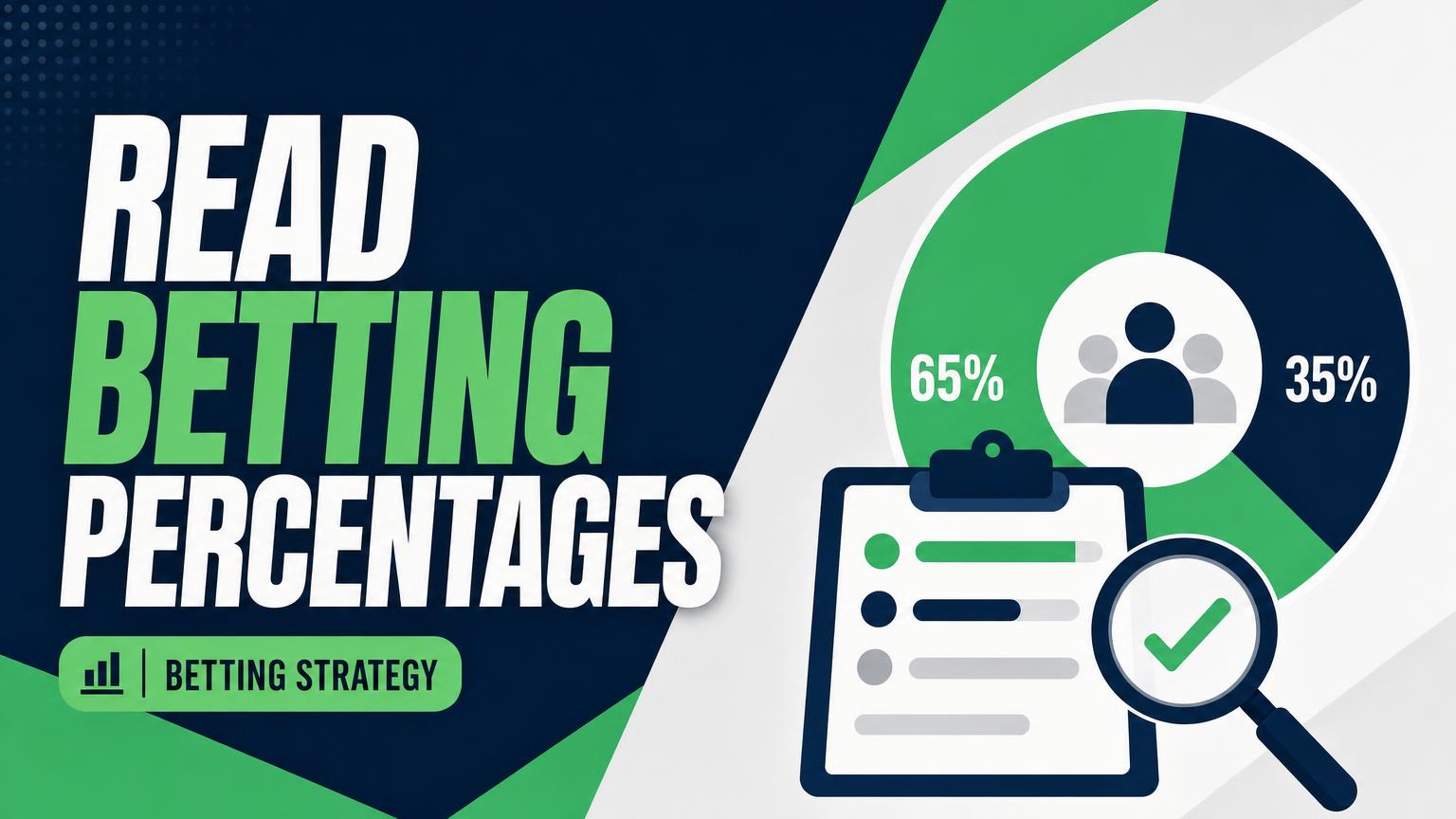
A lopsided public side can look decisive—until another screen shows the opposite.
One graphic shows 68% of Super Bowl bets on the favorite; minutes later, a social post claims big money favors the underdog. Both may be accurate. One could track tickets, the other dollars wagered, while each uses a different sportsbook, market, or update time.
Top NFL Offshore Sportsbooks for August 2026


The polished presentation creates false certainty. Even adjacent promotions—such as get up to $3,000 Welcome Bonus at BetUS sportsbook—can make a betting page feel more authoritative without strengthening its data. Sentiment is most useful as context for price movement and market timing, not as a shortcut to a pick.
Tickets count bets; money counts dollars
- Ticket percentage
The share of reported bets placed on one side. If Team A receives 90 of 100 wagers, it has 90% of the tickets, regardless of bet size.
- Money percentage
The share of reported dollars wagered on one side. It gives larger bets more influence than smaller ones.
- Ticket–money split
Suppose Team A gets 90 bets of $20, while Team B gets 10 bets of $500. Team A holds 90% of tickets but only 26.5% of the $6,800 wagered; Team B has 10% of tickets and 73.5% of the money.
- Reported activity
A split reflects only the bets visible to the operator, sportsbook group, or data provider publishing it. It is not a complete count of all Super Bowl betting.
- Sample limitation
A small or unrepresentative pool can make percentages look more meaningful than they are. One unusually large wager may sharply change the money split without changing ticket share much.
Confirm what each percentage actually measures
Two split figures are comparable only when their labels and reporting conditions line up. A quick five-part check prevents most misleading conclusions.
Compare spread tickets with spread tickets, moneyline handle with moneyline handle, and totals with totals. Ticket share from one market should not be set against money share from another.
Splits can move after a line change, injury report, or large wager. Figures captured on different days—or even several hours apart near kickoff—may describe different betting conditions.
Promotional eligibility, limits, and terms vary. Betting-split percentages may also be rounded, delayed, or based on undisclosed sample sizes.
Why Super Bowl splits behave differently
Super Bowl betting attracts far more recreational volume than a typical NFL game. Team loyalty, office-pool thinking, and interest from viewers learning how to start betting the Super Bowl can push ticket percentages toward familiar teams, star quarterbacks, and popular long-shot props.
Why timing matters
Early wagers often arrive from bettors reacting to the opening line, matchup data, or an expected price change. That does not make the early side automatically correct; initial opinions can misread injuries, tactics, or market demand.
Game-day splits absorb a much larger wave of fandom, television commentary, social-media narratives, and impulse bets. Promotions—including get up to $3,000 Welcome Bonus at BetUS sportsbook—may also bring additional activity, making late ticket counts especially noisy.
A useful comparison checks three details:
- When the split was recorded
- Whether tickets or money changed most
- Whether the betting line moved with that change
Late money is not necessarily expert money, just as early money is not inherently sharp. Super Bowl percentages are best treated as snapshots of changing participation, not verdicts on which side will win.
Four ways splits and lines interact
No betting split tells the full story. Pair the snapshot with the current price and timestamp, then review what to examine when a line moves before assigning a motive.
- Aligned action and movement: If tickets and money favor Team A while its spread moves from -2.5 to -3, demand may be driving the market. A confirmed injury or market-wide adjustment can look identical.
- High tickets, lower money: A side with 70% of bets but 48% of money suggests recreational popularity and larger average wagers on the opponent. It may hint at respected action, but reporting windows and a few large bets can distort the split.
- Lopsided action, stationary line: Heavy tickets and money with no move may mean the sportsbook accepts the liability, expects buyback, or is protecting a key number. Low limits can make early percentages look dramatic without forcing a change.
- Movement against the popular side: If most tickets back Team A while its price becomes more favorable, the pattern is often called reverse line movement. Larger wagers, injuries, or moves at influential books may be responsible; presumed “sharp action” remains an inference, not proof.
Promotions can add small-bet volume, too. An offer to get up to $3,000 Welcome Bonus at BetUS sportsbook should be judged by its terms, not treated as a market signal.
A line may move before public bets arrive. Comparing timestamps and several sportsbooks helps prevent the latest percentage from being mistaken for the cause.
Look for corroborating evidence
A split gains context when it agrees with other evidence. Check whether several sportsbooks moved together, whether prices changed around injury news, and whether money percentages match ticket counts. These simple indicators tied to public percentages can support a reading, but none reveals who placed the wagers.
Be cautious when movement appears at one book, follows a promotion, or reverses quickly. An apparent sharp-versus-public pattern may reflect risk management rather than conviction. Bettors comparing offers may see an opportunity to get up to $3,000 Welcome Bonus at BetUS sportsbook; bonus terms require a separate evaluation, not a market interpretation.
The market changes the meaning
A 70/30 split does not carry a universal message. Its significance depends on what is being bet and how that market is priced.
- Point spreads: The posted number is crucial. Support for a favorite at -2.5 is not equivalent to support at -3.5, where the bet must clear a key margin. Percentages without the corresponding spread and timestamp are incomplete.
- Moneylines: Dollar shares are distorted by price. Betting an expensive favorite requires more money to win the same amount, while popular teams often attract casual backing regardless of value. A large money percentage may therefore reflect odds, fandom, or both.
- Totals: Recreational bettors tend to find the over more intuitive and entertaining, particularly in the Super Bowl. Heavy over tickets are common and do not automatically reveal informed opinion.
Promotions can add further noise. Offers such as “get up to $3,000 Welcome Bonus at BetUS sportsbook” may encourage extra recreational bets, making ticket volume harder to interpret.
Player-prop splits are especially fragile. These markets usually have smaller samples, lower betting limits, and prices that move quickly. A few wagers can create dramatic percentages that look more meaningful than they are.
A six-check routine before reading the splits
-
Record the opener
Write down the opening spread, total, or moneyline from the same sportsbook that supplies the betting percentages.
-
Capture the current price
Note both the line and its odds. The available number matters more than whether a side is labeled “public” or “contrarian.”
-
Separate tickets from dollars
Confirm which percentage counts bets and which measures money; the difference may reveal unequal wager sizes, not sharper forecasting.
-
Check the timestamp
A split from this morning and a line from this afternoon do not form a valid comparison. Look for the latest update time on both.
-
Compare several sportsbooks
Use quick line comparisons across sportsbooks to see whether movement is market-wide or isolated to one operator.
-
Review relevant news
Check injuries, lineup decisions, weather, and credible reports before attributing movement to bettors. Then interpret the percentages alongside the recorded prices.
Repeat the same sequence for each market; spreads, totals, moneylines, and props can tell different stories.
Three Myths About Betting Splits
Super Bowl parlays often combine a favorite, its star scorer, and the over—three selections tied to the same game script. That correlation helps explain how public money can shape parlays without creating three independent signals.
Promotions matter too. An offer saying get up to $3,000 Welcome Bonus at BetUS sportsbook may influence where and how customers bet; it does not validate the popular side. Splits are contextual evidence, not a standalone system.
- Verify the source Confirm that the split comes from a named sportsbook or credible aggregator and carries a recent timestamp.
- Match the metric Separate ticket share from money share, then match the percentage to the spread, moneyline, total, or prop.
- Check the context Review meaningful line history alongside injuries, weather, lineup changes, and other market-relevant news.
- Protect the price Require an acceptable number and price; a reasonable read at -3.5 may become a poor bet at -4.5.
Before kickoff, stake size and loss limits should already be fixed. Late split changes rarely justify an impulsive wager, especially when the source, timing, or reason for movement remains unclear. Passing is often the best decision when the evidence stays ambiguous.
Promotions deserve the same price-conscious review. Anyone considering the offer to get up to $3,000 Welcome Bonus at BetUS sportsbook should check eligibility, rollover rules, and withdrawal terms. Ultimately, betting percentages explain market behavior better than they predict the Super Bowl.
