
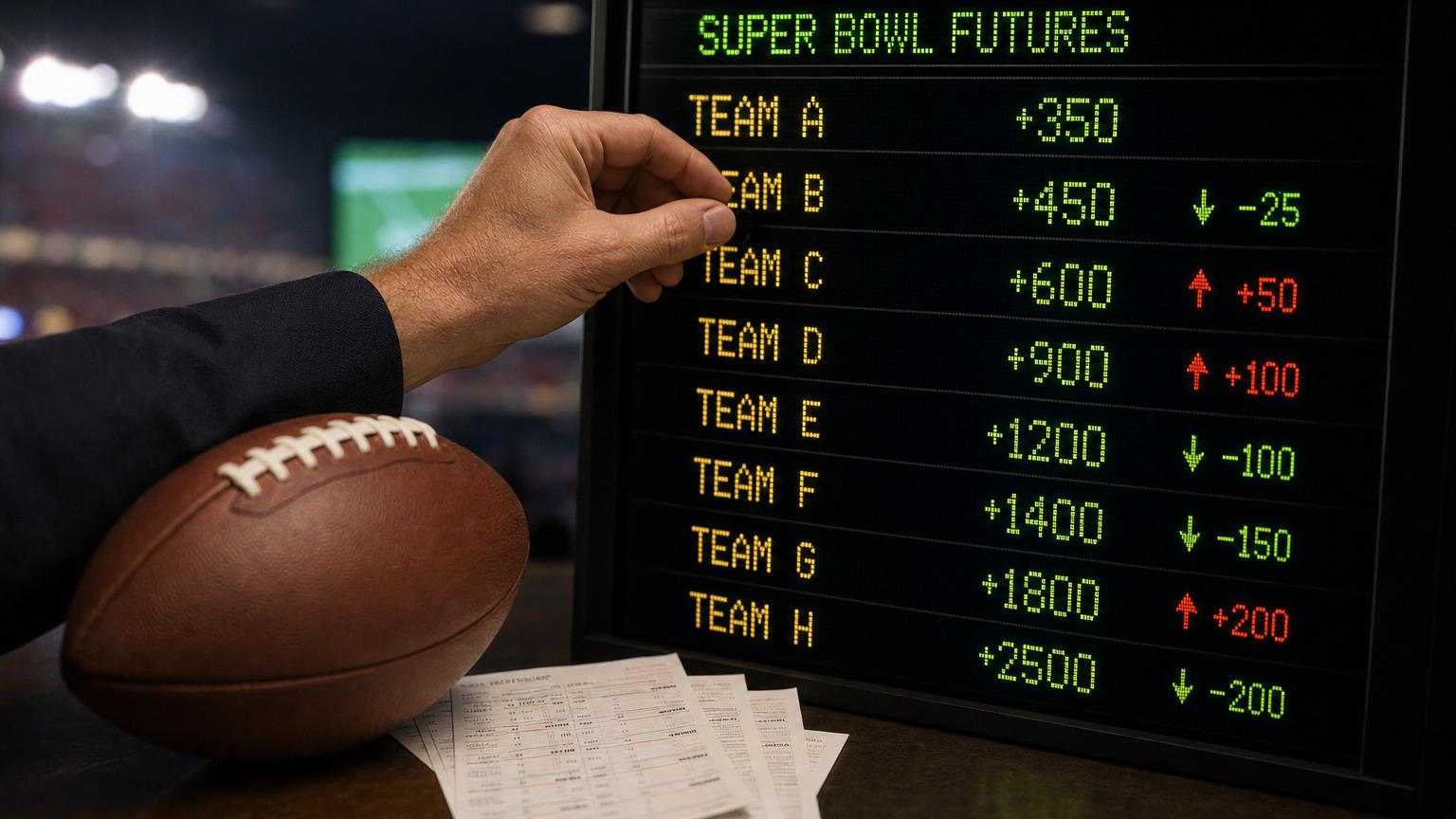
A futures board is less crystal ball than shop window.
Kansas City might sit at +650 in one app, +700 at another, and +600 somewhere else before a single injury report changes. That mismatch is not a glitch. A Super Bowl futures price is a market number built from estimated team strength, the sportsbook’s margin, current betting demand, and how much risk the book already has on its sheet.
Top NFL Offshore Sportsbooks for October 2026

BetUS

BetNow

MyBookie

Bet105

BUSR Sports

Everygame Sports

BetOnline

BetWhale

BetAnything

Xbet

Bovada

Bookmaker
The key is that odds are not pure probabilities. They are probabilities with a business layer attached. A popular team may be shaded shorter because casual money keeps arriving. A quieter contender may drift longer because the book needs action on that side. Timing matters too: after free agency, the draft, schedule release, preseason injuries, or one nationally televised blowout, the board can move before the underlying true chance changes much.
- +700 implies about a 12.5% chance before accounting for sportsbook margin.
- Promo note: eligible customers may see get up to $3,000 Welcome Bonus at BetUS sportsbook; terms shape the real value.
The moving parts inside a futures price
- Super Bowl future
A Super Bowl future is a bet placed now on which team will win the championship later. For a fuller primer on how Super Bowl futures work, the key idea is simple: the price is locked in while the season keeps changing around it.
- Time horizon
Unlike a single-game line, a future must survive months of injuries, schedule swings, trades, weather, playoff seeding, and coaching decisions. The longer the gap between bet and result, the more unknowns the sportsbook has to price.
- Locked-in number
Once the wager is placed, the odds do not move for that ticket. That can be valuable if a team improves, but painful if a quarterback gets hurt or the market was too optimistic.
- Unresolved variables
A futures price is not just a team rating; it also reflects the path to the title. Division strength, likely playoff opponents, home-field chances, and roster depth all matter before the Super Bowl matchup even exists.
- Bonus context
Promotions can affect the real cost of taking a long-term position; for example, players may see offers to get up to $3,000 Welcome Bonus at BetUS sportsbook. The headline odds still need separate judgment from the bonus terms.
The first layer is team strength
Before public money, promotions, or liability enter the picture, a sportsbook needs a baseline view of how good each team is. That usually starts with a power rating: a number meant to compare teams on neutral ground. It may blend last season’s results, quarterback play, roster changes, coaching, injuries, schedule strength, and market expectations.
That rating is then pushed through the season. A team is not simply assigned “12% to win the Super Bowl” out of thin air. Its strength is translated into a series of smaller probabilities:
- Chance to win each regular-season game
- Chance to reach a certain record
- Chance to win the division or earn a wild card
- Chance to get a favorable seed
- Chance to win each possible playoff matchup
This is why two teams with similar talent can have different futures prices. One may face a softer division, a cleaner path to the No. 1 seed, or fewer likely road playoff games. Another may be strong but stuck behind an elite conference rival, which lowers its path probability.
From rating to price
In simple terms, the book asks: If this season were simulated thousands of times, how often would this team end up champion? If the answer is about 5%, the fair price is near +1900 before margin. If it is 10%, the fair price is near +900.
That framing makes Super Bowl futures less mysterious. The posted odds are a translation of projected team quality, schedule path, and playoff survival rate. Bettors comparing markets, including offers such as get up to $3,000 Welcome Bonus at BetUS sportsbook, are really comparing how each book prices that path.
The Hold Is Hidden in the Whole Board
A Super Bowl futures board is not priced like a single game with two sides. It may list 32 teams, and each price can look defensible on its own. The catch appears only after converting every price into implied probability and adding the results together.
If a fair market had no sportsbook margin, all teams’ true championship chances would total 100%. In practice, the listed odds often add up to far more. That extra percentage is the hold: the book’s built-in cushion across the entire market.
For example, a simplified board might imply:
| Team group | Combined implied chance |
|---|---|
| Top contenders | 48% |
| Playoff-level teams | 42% |
| Long shots | 28% |
| Total | 118% |
That 118% total does not mean the league suddenly has more than one champion. It means the bettor is buying into a market where the prices, collectively, are about 18 percentage points above fair probability before any opinion about team quality is considered.
This is why futures can feel attractive while still being expensive. A favorite at +600 may not be wildly wrong, and a long shot at +5000 may not be absurd. But if nearly every team is trimmed slightly below fair payout, the board becomes costly as a package.
The practical lesson is simple: judging one number in isolation is risky. A cleaner read comes from comparing prices across multiple sportsbooks, estimating the full market hold, and treating unusually high totals as a warning sign. Promotions can soften the entry point—for example, eligible players may get up to $3,000 Welcome Bonus at BetUS sportsbook—but bonus value does not turn a heavily juiced futures board into a fair one by itself.
Convert each team’s odds to implied probability, add them together, then subtract 100%. A 110% board is meaningfully different from a 125% board, even if the headline favorites look similar.
Popularity Has a Price
A sportsbook is not only pricing who is most likely to win. It is also managing the teams customers most want to bet. In Super Bowl futures, that often means defending champions, big-market franchises, star-quarterback teams, and clubs that “won the offseason” get extra attention.
That demand can push prices lower than a rating-only view would support. A team might deserve 12/1 on a neutral model but sit at 9/1 because casual bettors keep adding it to futures slips. The book does not need to offer the best possible number on a popular side if money is likely to arrive anyway.
Common public magnets include:
- Recent champions with a fresh playoff memory
- Elite quarterbacks who attract confidence even when the roster has flaws
- Large fan bases that bet with loyalty, not just price
- Splashy offseason teams after major trades, free-agent signings, or draft buzz
This is where quieter teams can become interesting. A solid roster in a smaller market, a defense-first team, or a club with an unglamorous quarterback may drift to a better number simply because fewer people are eager to click it. The team still has to be good enough, but the price may carry less popularity tax.
Shopping matters here. Different books shade different fan bases and liabilities, so comparing markets can reveal which number is inflated and which is merely ignored. Promotional bankroll can also affect where a bettor starts; for example, eligible new customers can get up to $3,000 Welcome Bonus at BetUS sportsbook, subject to its current terms.
Not Every Move Is a Message
A futures price can move for good football reasons. A quarterback injury, a coordinator change, a major trade, or a shift in playoff seeding can all change a team’s real title chances. In those cases, the board is reacting to information that should affect the underlying probability.
But not every shorter price means the sportsbook has uncovered something predictive. Sometimes the move is mostly about bettor pressure. If a popular team draws heavy action after a primetime win, a book may trim its odds to slow new bets, even if its internal rating only changed a little.
There is also book-specific exposure. One sportsbook might already have a large liability on a team from earlier bets, while another has a cleaner position. That can produce different prices across the market, especially in futures, where tickets sit open for months.
A useful habit is to compare the move with the news cycle and the broader market:
- Did several books move at the same time?
- Did only one book adjust sharply?
- Was there actual team news, or just public excitement?
- Did the price move after a high-profile game?
Promotions can add another layer. For example, players may see offers such as get up to $3,000 Welcome Bonus at BetUS sportsbook, but the bonus should be considered separately from whether the futures number itself is fair.
The key is simple: a price move is a clue, not proof.
A shorter number may signal better title chances, but it may also reflect public money or a book protecting itself. Checking multiple sportsbooks helps separate market-wide information from one book’s risk management.
Catalysts That Actually Move the Board
Super Bowl futures can sit still for weeks, then reprice sharply when the market gets information that changes a team’s path. The fastest moves usually follow quarterback injuries, because one player can swing win totals, playoff seeding, and title probability at once. A confirmed season-ending injury may be gone from the board before casual bettors even compare prices.
Other roster losses matter too, especially when they hit premium positions: left tackle, edge rusher, cornerback, or multiple starters from the same unit. A single defensive injury may not transform a contender, but a thin secondary losing two starters can change how oddsmakers grade every matchup.
Coaching changes, coordinator hires, and scheme shifts are slower-burning catalysts. The market may agree that a proven coach adds stability, but disagree on how quickly the effect shows up. That uncertainty can leave interpretation gaps.
The same applies to the NFL Draft and free agency. A team landing a franchise quarterback, elite pass rusher, or badly needed offensive line help can shorten, but books tend to react quickly when the fit is obvious. Debatable moves create more room for opinion: an aging star, a crowded receiver room, or a rookie expected to contribute immediately.
Schedule release also adds reality to projection. Long road stretches, rest disadvantages, and a brutal division can trim optimism. Anyone shopping futures should compare several books; promotions such as get up to $3,000 Welcome Bonus at BetUS sportsbook may be useful, but price still matters more than the bonus.
Where the edge actually hides
A Super Bowl future is not attractive because a team “feels live.” It becomes interesting when the posted price is better than a reasonable estimate of that team’s real chance, and that gap is usually small. The practical hunt is for mispriced probability, not a perfect prediction.
The most common edge starts with shopping. A team at +1800 at one sportsbook and +1400 at another is the same bet with very different math, so it is essential to compare futures prices between books before judging value. Without that step, a bettor may simply be taking the worst number in the market.
Useful spots often come from:
- Stale prices: one book reacts slower to injury news, schedule shifts, or playoff seeding changes.
- Misread paths: a team may have a tougher or easier postseason route than its headline record suggests.
- Public bias: popular teams can be shortened beyond their true probability.
- Overreaction: one ugly loss, quarterback rumor, or weather-affected game can move sentiment too far.
Promotions can improve the overall account setup, including offers such as “get up to $3,000 Welcome Bonus at BetUS sportsbook,” but a bonus should not turn a bad futures number into a good one. The price still has to stand on its own.
The best habit is simple: write down the best available number, estimate the implied probability, then ask what the market may be missing. If the answer is only “this team is good,” the edge probably is not there.
Promos Can Help, but the Number Still Matters
A sportsbook promotion can improve a futures bet’s expected value, but it should not turn a bad price into an automatic play. A bonus changes the math around stake, risk, and return; it does not make +650 attractive if the fair market is closer to +900 elsewhere.
For example, a reader may see an offer to get up to $3,000 Welcome Bonus at BetUS sportsbook. That can be worth considering, but only after reading the terms and conditions: rollover requirements, eligible wagers, minimum odds, expiration windows, and whether futures bets count differently from straight bets.
The same discipline applies after the bonus is credited. Before tying up money for months, the bettor should compare:
- Odds quality across several books
- Rollover rules and how hard they are to clear
- Limits on futures and promotional wagers
- Availability by location and account status
- Withdrawal rules, fees, and processing times
Promos are best treated as a small boost at the margin. The core edge still comes from finding the best price on a bet that was already worth making.
A larger headline bonus is not always better than a smaller, cleaner offer. Restrictions, rollover, and weak odds can erase much of the apparent value.
A Simple Futures Check Before Betting
-
Convert the price
Turn the odds into implied probability first. +1200 is not just a big payout; it means the market is asking whether the team wins the Super Bowl more than about 7.7% of the time before adjusting for vig.
-
Compare several books
A half-point in probability matters on futures. Check at least a few prices, including promos carefully; offers such as get up to $3,000 Welcome Bonus at BetUS sportsbook can help only if the listed number and terms still make sense.
-
Judge the playoff path
A strong team can be a poor bet if its likely seed, division, or conference road is brutal. Look beyond roster talent to the opponents it may need to beat.
-
Review real catalysts
Quarterback health, line injuries, defensive losses, coaching changes, and schedule breaks deserve more weight than vague momentum talk.
-
Check for public tax
Popular teams often carry shorter prices because casual money keeps arriving. If the case depends mostly on brand name, recent highlights, or media volume, caution is warranted.
-
Protect the bankroll
Futures tie up money for months and usually lose. Small stakes, fewer bets, and a willingness to pass are often the sharpest tools available.
- A futures bet needs both a believable title case and a price that underrates that case.
- The best number is usually found before excitement reaches the market, not after.
- No bet is a valid conclusion when the board has already caught up.
Super Bowl futures are tempting because they turn a small stake into a long-running sweat. The better habit is slower: translate the odds, compare the market, test the path, and separate meaningful news from noise.
Passing is not indecision. In a high-hold market with months of uncertainty, waiting for a cleaner price can be more valuable than forcing an opinion today.
Top NFL Offshore Sportsbooks for October 2026
BetUS
BetNow
MyBookie
Bet105
BUSR Sports
Everygame Sports
BetOnline
BetWhale
BetAnything
Xbet
Bovada

3 comments on “How Sportsbooks Set Super Bowl Futures Prices and Where the Edge Hides”
Curious how you’d handle a “great team, brutal path” case.
Like if a team’s power rating says they’re top 3 in the league, but their conference is stacked and their likely playoff route includes two road games, do you mostly fade them in futures even if the raw number looks decent? I feel like people talk about team strength way more than path, but path is half the bet in the NFL playoffs.
The “not every move is a message” part is the one I struggle with most.
If a team drops from +1800 to +1200 at one book but stays around +1700 elsewhere, is that almost always just liability/demand at that book? Or can it be a sign that the slower books haven’t caught up yet?
I get the idea of cross-book comparison, but in real time it’s hard to know whether you’re finding a stale number or just chasing noise 😅
That’s exactly the right tension. A single-book move by itself usually shouldn’t be treated as “information” unless it lines up with news or a broader market move.
If one book goes +1800 to +1200 while most of the market is still +1600/+1700, I’d first assume book-specific liability, public demand, or a risk-manager adjustment. The edge may actually be on the books that *didn’t* move only if you have a clear reason the true price should be shorter — injury news, schedule shift, QB change, etc.
A good rule of thumb: broad, simultaneous movement is more likely signal; isolated movement is more likely housekeeping.