
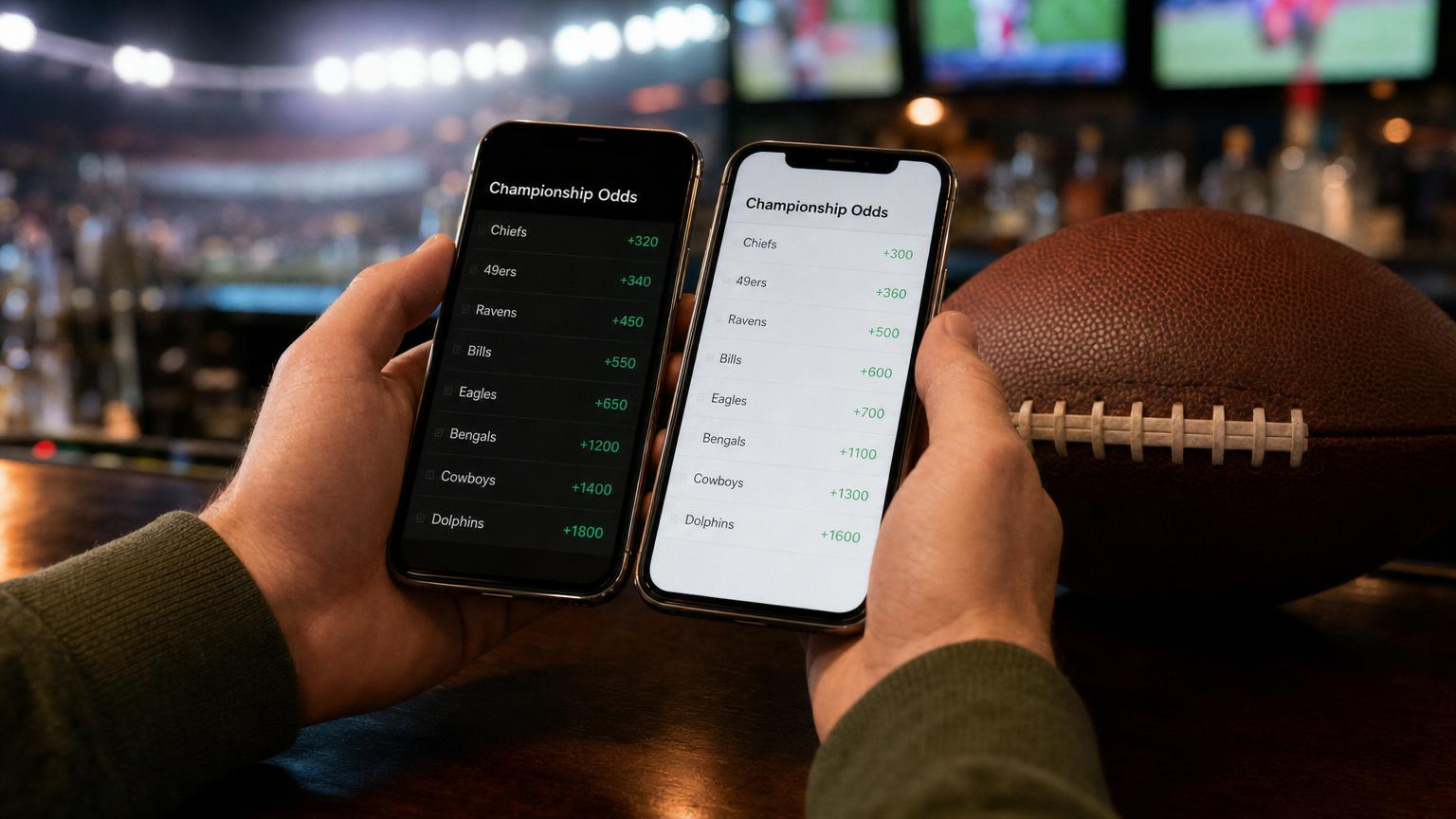
One team, three prices, and suddenly a simple futures bet feels less simple.
A bettor might see the 49ers at +650 on one sportsbook, +700 on another, and +600 somewhere else before kickoff is even close. That can feel like someone is “wrong,” but in Super Bowl futures it is usually normal. Books shade prices based on their own risk, customer action, market timing, and how aggressively they want to attract bets on a team.
Top NFL Offshore Sportsbooks for October 2026

BetUS

Bet105

BetOnline

BetWhale

BetAnything

Xbet

Bovada

MyBookie

Bookmaker

BetNow
That difference matters because futures tie up money for months. A small gap can change the long-term value of the same pick, especially for anyone still learning how Super Bowl futures are explained. Promotions can also affect the decision; for example, eligible players may get up to $3,000 Welcome Bonus at BetUS sportsbook, but the posted odds still deserve a separate look.
- A move from +600 to +700 is not cosmetic; it meaningfully changes potential payout.
- Compare the same team, same market, and same bet type before judging value.
Why Super Bowl futures prices differ by sportsbook
Why is there no single market-wide Super Bowl futures price?
Each sportsbook carries its own risk. If one book has taken heavy bets on the Bills, for example, it may shorten Buffalo’s odds while another book with little exposure keeps a better number available. That is a core part of how sportsbooks price futures markets.
How does liability change a futures line?
Futures bets stay open for months, so a popular team can create a large potential payout for the book. Moving that team to a shorter price discourages more action and nudges bettors toward other outcomes. The move is not always a pure opinion on team strength.
Do margins explain some of the difference?
Yes. One book may build a higher hold into its Super Bowl board, while another may compete with slightly better prices on selected teams. This is why two books can agree on a team’s chances but still post different odds.
Can news timing create temporary gaps?
Injuries, trades, coaching changes, and quarterback updates do not hit every board at the exact same second. A book that reacts quickly may move first, while another may wait for confirmation or betting activity. Short-lived differences often appear around major news.
Do promotions and sharp bettors affect futures prices?
Promotions can make a book more willing to feature certain offers, such as get up to $3,000 Welcome Bonus at BetUS sportsbook, while still adjusting the actual odds for risk. Sharp action can also force a faster move if respected bettors attack a number. Recreational demand may move prices too, but usually with less urgency.
Is the biggest plus number always the best Super Bowl futures bet?
Is +900 automatically better than +750?
Not always. +900 pays more than +750, but it only helps if the team’s real chance of winning is high enough to justify the bet.
What does +900 mean in plain terms?
A +900 price returns $900 in profit on a $100 winning bet. It also suggests an implied probability of about 10%, before accounting for the sportsbook’s built-in margin.
How does +750 compare?
+750 implies roughly an 11.8% chance. So the question is whether the gap between 10% and 11.8% reflects a real bargain or just a longer shot with a tempting payout.
When is the higher payout worth taking?
The bigger number has value when a reasonable estimate of the team’s title chance is higher than the implied probability. If a bettor believes a team has a 13% chance and finds +900, that price is more attractive than +750.
Do bonuses change the comparison?
Promotions can improve the overall deal, but they do not make a weak futures price strong on their own. For example, get up to $3,000 Welcome Bonus at BetUS sportsbook may matter when comparing accounts, while the odds still need to stand up on value.
Divide 100 by the potential total return. For +900, that is 100 ÷ 1000, or about 10% implied probability. For +750, it is 100 ÷ 850, or about 11.8%.
A higher payout is useful only when the team’s realistic chance is better than the number suggests.
How can Super Bowl futures odds be compared across sportsbooks?
-
Start with the exact market
The same team price can mean different things if one book lists “winner,” another uses conference futures, or a promo page has special conditions. Confirm the event, settlement language, and whether overtime or any season-cancellation rules affect grading.
-
Convert the odds to implied probability
For plus odds, divide 100 by the odds plus 100: +900 equals 10.0%. For negative odds, divide the minus number by that number plus 100. This makes a +1200 versus +1000 gap easier to judge than the raw payout alone.
-
Place the team in a realistic tier
A short favorite, a clear contender, and a long-shot wild card should not be compared the same way. A half-point of perceived probability matters more on elite teams, while long shots often need a much larger price gap to offset the uncertainty.
-
Check limits and availability
A great displayed number has less value if the maximum stake is tiny, the line moves before the bet is accepted, or the account has different limits on futures. Futures also tie up bankroll for months, so a slightly worse price with usable limits may be more practical.
-
Read the house rules before chasing the edge
Key details include whether bets stand if a quarterback is injured, if a team relocates games, or if the season format changes. Futures are usually “all in” once placed, so rule differences can matter as much as a small odds difference.
-
Factor in account value, not just payout
Bonuses, payment options, and market depth can tilt a close call, provided the terms are clear. For example, eligible players may get up to $3,000 Welcome Bonus at BetUS sportsbook, but rollover, expiry, and qualifying-bet rules should be weighed alongside the futures price itself.
The best comparison usually combines price, probability, rules, and usability rather than selecting the largest number automatically.
When do Super Bowl futures boards usually spread apart?
Which offseason periods create the biggest gaps?
Free agency and the draft often move boards unevenly because books do not all update team strength at the same speed. A quarterback upgrade, offensive-line rebuild, or surprise trade can shorten one team quickly at one sportsbook while another leaves a stale price available for a short time.
Why do quarterback injuries matter so much?
A quarterback injury can change a team’s Super Bowl outlook more than almost any other single event. Futures prices may diverge while books judge recovery timelines, backup quality, schedule difficulty, and whether bettors are overreacting to limited information.
Can coaching changes affect futures prices?
Yes, especially when a new coach changes the offensive system, defensive structure, or late-game decision-making profile. Some books shade prices based on public excitement around a hire, while others wait for roster fit and market confirmation.
Do early-season results create misleading movement?
September can produce large swings from one upset, one dominant win, or one ugly prime-time loss. This is where knowing the best month to buy futures can matter, because the market may still be sorting signal from noise.
How does the long timeline affect price differences?
Super Bowl futures carry months of uncertainty, so every injury report, trade rumor, suspension, and schedule development can be priced differently. Bettors comparing boards may also factor in promotions, such as get up to $3,000 Welcome Bonus at BetUS sportsbook, while still treating the posted odds as the main number.
Should a Super Bowl futures price gap be bet right away?
When is a price gap worth acting on immediately?
A gap is more urgent when the number is clearly out of step with the market and likely to move after news, injuries, or sharp action. If +1800 is widely +1400 elsewhere, waiting may erase the edge.
When is it better to monitor the line?
Monitoring can make sense when the gap is small, limits are low, or the reason for the move is unclear. The question is less about fear of missing out and more about whether buying now or waiting fits the price risk.
How do bonuses affect the timing decision?
A promotion can soften a slightly worse number, but it should not hide a bad futures price. For example, bettors may see “get up to $3,000 Welcome Bonus at BetUS sportsbook,” then still compare the actual Super Bowl odds.
What is the main risk of waiting?
Time creates opportunity, but it also adds uncertainty. A better number may appear, or the market may move before the bet is placed.
A simple checklist before betting a Super Bowl future
-
Match the exact market
Compare the same team, same outright Super Bowl winner market, and same season. Conference, division, and “to make the playoffs” prices are different bets, even when they sit beside futures on the same page.
-
Turn the odds into a rough probability
A bettor does not need a perfect model, but the number should make sense against a fair estimate of the team’s chance. This matters most with longshot futures and expected returns, where a few odds points can change the value more than it first appears.
-
Check the house rules and limits
Before treating one book as better, note max stake, cash-out availability, settlement rules, and whether promotional funds have restrictions. A bigger price with awkward terms may be less useful than a slightly shorter clean number.
-
Account for bonus value carefully
Promos can improve the overall deal when the rules are understood. For example, eligible new customers may get up to $3,000 Welcome Bonus at BetUS sportsbook, but bonus terms should be read before counting that value.
-
Bet only if the price still holds up
The highest number is not an instruction to act. If the estimated edge disappears after probability, timing, and terms are considered, passing is a valid decision.
- Small futures gaps matter more when the payout is long and the market is slow to update.
- A shorter price with clearer terms can beat a larger number that is hard to use.
- No sportsbook price has value without a separate view of the team’s real chance.
Super Bowl futures shopping works best as a filter, not a trigger. The practical rule is simple: compare the same team and market, estimate the implied chance, review the terms, and bet only when the remaining number still looks attractive.
The biggest posted payout can be useful, especially on longer shots, but it should not create pressure to fire. Sometimes the best futures decision is to record the price, keep watching the board, and wait for a cleaner edge.
Top NFL Offshore Sportsbooks for October 2026
BetUS
Bet105
BetOnline
BetWhale
BetAnything
Xbet
Bovada
MyBookie
Bookmaker

3 comments on “Why Super Bowl Futures Prices Differ Between Books and How to Compare Them”
One thing I’m still fuzzy on: how do you factor in cash-out availability for Super Bowl futures when comparing books?
I know the article talks about rules, limits, and bonus value, but if Book A has +1100 and usually offers decent cash-out and Book B has +1200 but basically no flexibility, I’m not sure the bigger number is automatically better. My own answer would be to treat cash-out like a small “option value,” but maybe not enough to take a meaningfully worse price. Curious if that’s how others think about it too.
Good question, and yes — I’d think of cash-out as optional value, not as a replacement for price. The tricky part is that cash-out offers are discretionary, can be pulled, and often include a built-in margin that favors the book.
If two futures prices are very close, a book with historically reliable cash-out may be preferable, especially for long holds where injury or seeding news can change your plan. But if the gap is meaningful, like +1200 versus +1000, I’d usually prioritize the better number and manage the position later through hedging or secondary bets if needed.
Do you ever compare Super Bowl futures by “path” instead of just true title probability? Like, a team might be 9% to win it all, but if they’re in a weak division or likely to avoid the 1-seed until later, that feels different than a team with the same projection stuck in a brutal conference.
My rough method is to price division/conference odds first, then decide if the Super Bowl number is actually out of line. Not perfect, but it keeps me from smashing every shiny +1600 I see like a raccoon with a betting account 😂